Sourcery (book proof) – Terry Pratchett

20190205sourcery1

The fifth Discworld novel by Terry Pratchett was published on 26th May 1988, before that however Gollanz released a sample for book reviewers and this was the only time that the book proof of one of Terry’s works was not the complete book. Instead what you got was just the first 61 pages and an essay from Terry explaining Discworld as it was still not well known. It is this short essay that makes this book so interesting as it has never been reprinted so you can only read it is you are one of the lucky few people that own a copy. It is not known exactly how many were printed but the proofs of books four and six in the series were both only of circa 100 copies produced so it is not unreasonable to assume that it is also the case for this example. The poor production value of what is basically a pamphlet with what looks like a bad black and white photocopy of the cover for an author who was not then famous would also suggest that not all of the printed editions were kept.

When Sourcery was printed for real the first edition (see below) ran to 7,600 copies, ten years later Carpe Jugulum (printed 5th November 1998) would have a first edition print run of 160,000 in the UK alone although the proof for that book was still only 148 examples. Pratchett UK book proof collecting takes a lot of looking to find copies and they are all rare.

20190205sourcery2

But back to the sample book proof, the essay inside describes how Terry saw the Discworld at the time, over the years this evolved and it is fascinating to read his views then, just four and a half years after the first book in a series that would eventually run to forty two novels, along with numerous other books, maps, plays etc. that added to the Discworld universe. The essay is headed

An Introduction to the series, composed by the Author, and included to make this special preview sample of Sourcery even more valuable as a collector’s item

In it he gives this description of why he invented Discworld in the first place

 It was created as an antidote to all those trilogies whose worthy heroes stagger across three volumes in order to do whatever it is that the fates have decreed that a hero must do. But fairy tales and folklore and all the feedstocks of fantasy have been dragged into it, and the humour gently teased out of them by the simple process of taking them seriously and staffing them with real people. This is very unfair on them, because it is like turning loose a large herd of cows in a small pottery.

This was indeed the case in the early Discworld books, the story is played for laughs and there is a strong sense of parody about the writing particularly in the ones up to and including Sourcery. The name of the novel by the way is also a joke and is deliberately spelled that way rather than Sorcery. The concept is that the eighth son of an eighth son is automatically a wizard of power but if he then goes on to have children each son would be as powerful as any existing wizard and if he has an eighth son then he would be a wizard squared and be all powerful with access to the source of all raw magic on the Disc hence a Sourcerer rather than a sorcerer. This duly happens and wizards start building towers to fight with one another, laying waste to the lands and peoples between; does this remind you of any three volume series by any chance? Pratchett specifically mentions Tolkien a little later.

Thus on the Discworld, wizards smoke. Nothing new about this Tolkien revealed to the world that wizards smoke. But on the Disc they really smoke, you can tell a wizard by his golden fingers, stained beard, tendency to cough when walking upstairs and, in the dark, by his little red glow.

The book goes on the amplify to the ridiculous numerous tropes of the fantasy novels up until then, barbarian heroes that are either like Cohen at 87 years old and sometimes needs to be carried off by the young maidens he has just rescued from sacrifice or patently unsuited for the role they have chosen such as Nijel who is far too polite for this sort of thing with his battle cry of “Erm, excuse me”. The book is very funny especially if you are well read in the sort of books that Pratchett is mercilessly parodying.

People keep asking for maps of the Disc, on the basis that all fantasy world have to have a map, but I retreat into my Somerset bunker and refuse on the ground that I may decide to move places around a bit if it makes a better joke.

As stated above there are now maps not just of the Disc itself but also specific regions but they weren’t created by Terry, instead Stephen Briggs eventually convinced him that it could be mapped, starting with the city of Ankh-Morpork and eventually the whole world and yes it did prove difficult because there wasn’t a map when the books were written and the lost continent of XXXX had to have a huge extension added just so that one of the books worked. The later books are also less parody of fantasy novels and more a humorous parody of life on Earth, back then Pratchett could never have seen where his work would take him and the millions of books he would sell, indeed he was somewhat bemused that it was as popular as it was even then.

the evolution of the books into a cult has rather perplexed me.

20190205sourcery3

At the time of writing there is a copy available on Abebooks should you be interested at a quite reasonable (considering its rarity) £225

Fables from the Fountain

OK this one needs a bit of an explanation before we get to the book. Back in 1957 the great science fiction writer Arthur C Clarke published a book of short stories that he had written over the preceding 4 years and had appeared in various places in that time. The stories were all linked as a series of tall tales told in a pub called the White Hart by one of the regulars there, Harry Purvis. I first came across the book in the mid 1970’s when I was about 11 or 12 during a period when I was avidly reading through not only Clarke’s work but that of the other two writers of the ‘big three’ in Sci-Fi, Robert Heinlein and Isaac Asimov. At first I wasn’t very interested, I was heavily into Sci-Fi and this was just a group of people in a pub telling stories, mind you some of them have a scientific base and they were funny so I persevered and grew to like the plot twists that were an invariable part of each tale. I no longer have the book, assuming I ever did, it could have been from the library, although I remember the cover well with a giant squid almost covering the pub and I have fond memories of the stories themselves.

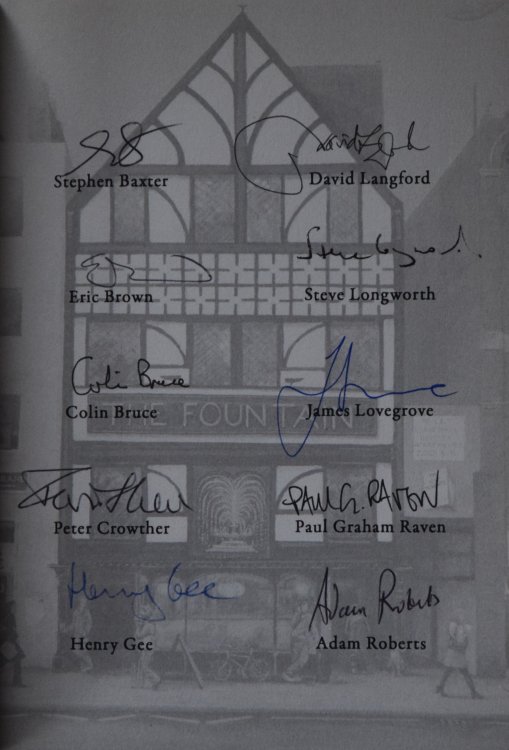
I found out many years later that The White Hart was based on a real pub called the White Horse in London where Sci-Fi fans and writers used to meet up in the 50’s. These included John Christopher (The Death of Grass, The Tripods Trilogy etc.), John Wyndham (The Day of the Triffids, The Kraken Awakes etc.) and of course Arthur C Clarke himself. Appropriately the concept of Fables from the Fountain was dreamt up in a London pub by Ian Whates a few weeks after Clarke’s death in 2008 and the day after the Clarke award ceremony for the best new science fiction novel released in Britain. Whates had founded Newcon Press a couple of years earlier and conceived a homage to Tales from the White Hart with stories by current authors who had all in their own way been inspired by the great innovator that was Sir Arthur C Clarke.

20180417 The Fountain 1

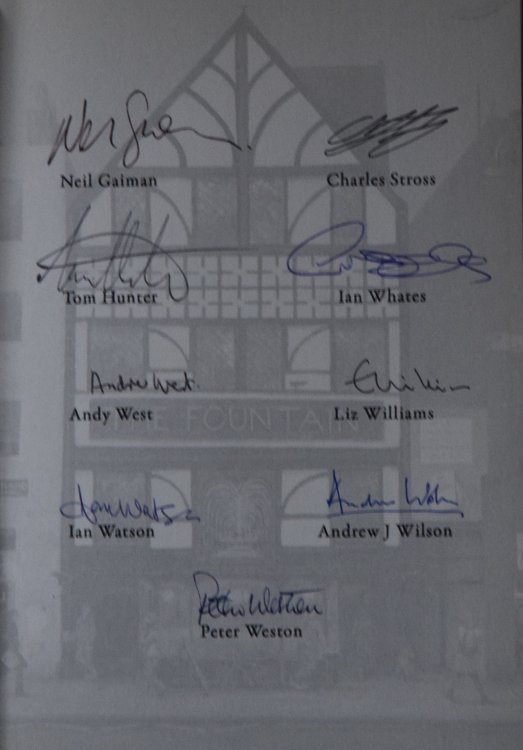
The various writers in the new book have taken pseudonyms to be characters who meet at the Fountain to swap stories. Unlike the original the tales are given from assorted standpoints, rather than always by Harry Purvis although it’s good to spot references to him in several of the narratives. Because of the nature of the tales it is difficult to say much about them, they are short because of the premise of the book that they are stories told over a pint or two. Some like Neil Gaiman’s brilliant piece are very short at 4½ pages, so it is hard to avoid giving away the twists and turns they manage in so few words. Rereading the book after almost seven years (it was published in May 2011) for this blog  has been an interesting experience, I was surprised by how many I didn’t remember the ending to even if I instantly recognised the pre-amble.

There is high science represented and some truly awful puns, Professor Mackintosh explains how his life was saved by smoking, we find out surprising things about Muscovy Ducks, whilst Heisenburg, Schroedinger and surprisingly even William Blake get name checks. One of my favourites is ‘On the Messdecks of Madness’ by Raven about which I can say almost nothing without spoiling the enjoyment except it’s the only fantasy story I can recall that uses the great diarist Samuel Pepys’s admiralty career as a basis of the plot. Whilst another explains the 1908 Tunguska explosion and of course there is the obligatory Area 51 tale without which no collection of stories aimed at SF geeks would be complete.

The full list of stories are as follows, I’ve included the introduction here partly because the book does as well in the numbering of the index and also because Peter Weston’s introduction is definitely worth reading.

  1. Introduction – Peter Weston
  2. No Smoke without Fire – Ian Whates
  3. Transients – Stephen Baxter
  4. Forever Blowing Bubbles – Ian Watson
  5. On the Messdecks of Madness – Paul Graham Raven
  6. The Story Bug – James Lovegrove
  7. “And Weep Like Alexander” – Neil Gaiman
  8. The Ghost in the Machine – Colin Bruce
  9. The Hidden Depths of Bogna – Liz Williams
  10. A Bird in Hand – Charles Stross
  11. In Pursuit of the Chuchunaa – Eric Brown
  12. The Cyberseeds – Steve Longworth
  13. Feathers of the Dinosaur – Henry Gee
  14. Book Wurms – Andy West
  15. The Pocklington Poltergeist – David Langford
  16. The Last Man in Space – Andrew J Wilson
  17. A Multiplicity of Phaedra Lament – Peter Crowther
  18. The Girl With the White Ant Tattoo – Tom Hunter
  19. The 9,000,000,001st Name of God – Adam Roberts

The copy I have is the hardback limited edition (number 61 of 200) and is signed by all 19 writers. At the time of writing the title is still available from Newcon Press, although now only in paperback and not signed from this link.

Now if you’ll excuse me it’s Tuesday; so it’s the get together night at the Fountain, Polish barmaid Bogna will be serving behind the bar and I can hear the call of a pint or three of Old Bodger, although I’ll be careful to avoid the Ploughman’s lunches.

20180417 The Fountain 2

20180417 The Fountain 3