Robert Hooke’s Micrographia

2nd January 1666

Thence to my bookseller’s and at his binders saw Hookes book of the Microscope which is so pretty that I presently bespoke it.

20th January 1666

so to my bookseller’s and there took home Hookes book of Microscopy, a most excellent piece, and of which I am very proud.

21st January 1666

Before I went to bed I sat up till 2 a-clock, in my chamber reading of Mr Hookes Microscopicall Observations, the most ingenious book that ever I read in my life.

I have to agree with Samuel Pepys, I have added this book to my library in the last week and like the celebrated diarist I have spent hours late into the night reading and looking at the wonderful illustrations. It is hard to imagine just how revolutionary a work it was in it’s time, nobody had seen anything like it before. Very few people had access to a microscope and very little had been printed with illustrations of what you could see with the use of one. Micrographia was the first book published by The Royal Society, just three years after the society had been granted it’s royal charter in 1662 making it the oldest scientific academy in the world. Pepys had become a fellow of the society on 16th February 1665 so knew Hooke and would have been well aware of the book before publication.

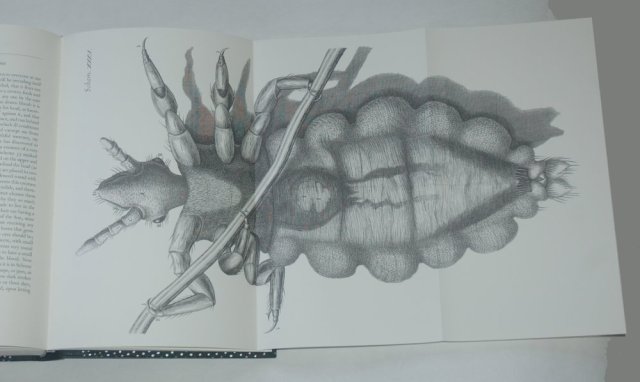
Now it may seem odd to write a review of a book that came out over 350 years ago but the edition published by The Folio Society is the first high quality version printed in the last 200 years and reproduces in full size the original plates including large fold out pages that are up to 2 feet (60cm) across. The book is consequently large at 13½” × 8¾” (34.3cm x 22.2cm) and quarter bound in leather. The cover is printed on cloth and based on the eye of a grey drone fly and was designed by Neil Gower.

20180305 Micrographia 1

Inside the illustrations are the first thing to catch your eye but then the text pulls you in. Although this is primarily an important, and in its time ground breaking, scientific work Hooke wrote for the interested layman and even after all these centuries it is still an engaging story. Instead of just describing the illustrations he explains why and how he came to look at them in the first place, you get his first impressions and you can share in his sense of wonder at what is revealed.
20180305 Micrographia 2

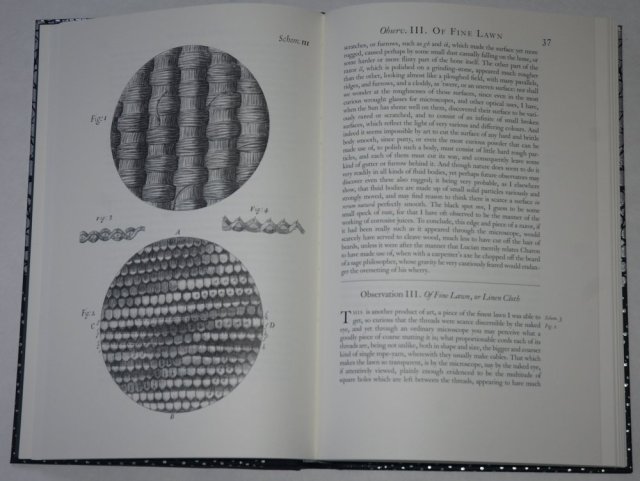
A study of a piece of cloth to reveal the weave, the end of a pencil, a needle, nothing is beyond his inquiring mind and everything he looked at and wrote about was new to the reader who would not have had access to anything like this before.
20180305 Micrographia 3

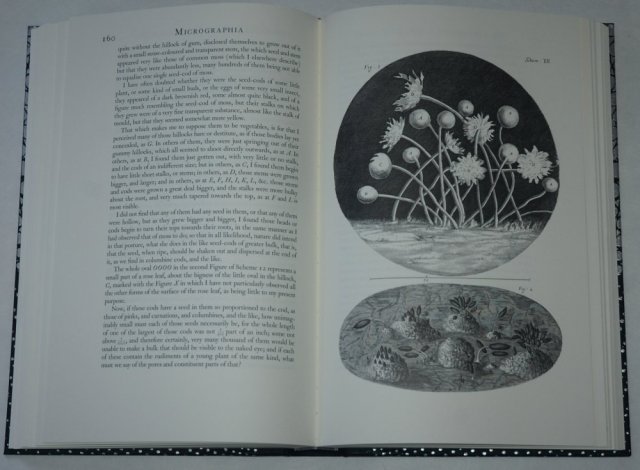
The picture above is of the black spots on the leaves of the rose bushes in his garden. To his surprise these turned out to be ‘tiny plants’ growing on the leaves themselves. Nowadays we understand what he is looking at but the text explains his reasoning that this is some sort of mould and the next thing he then examines is a blue mould on a book bound in leather from a sheep to see if his premise is valid. You learn with Hooke and it’s no surprise that Pepys found the book so fascinating.
20180305 Micrographia 4

The large fold out plates are possibly the most famous pictures in the book and The Folio Society have reproduced pages from original 1st and 2nd editions (whichever were the best examples) held in the Bodleian Library in Oxford. There is also a small section at the end where Hooke turns his attention away from the very small to the very large and includes some observations he made with a telescope including an early map of part of the moon.

20180305 Micrographia 5

It really is a joy to own and read this book, which was published in 2017 in a limited edition of just 750 copies, mine is number 635. Whilst I love the normal production of The Folio Society and have over 400 books printed by them; it is their limited editions that are their crowning glory. Printed on the finest paper and treated as a work of art in their own right these books are rightly regarded as something special and Micrographia was the winner of the “Scholarly, Academic and Reference Book” category at The British Book Design & Production Awards 2017. A fantastic addition to any library.

There is a video of the book from The Folio Society on YouTube which  gives a better idea as to the size and beauty of this amazing work and this makes an interesting comparison to a video from The Bodleian Library about their first edition.
 

The Original Alice

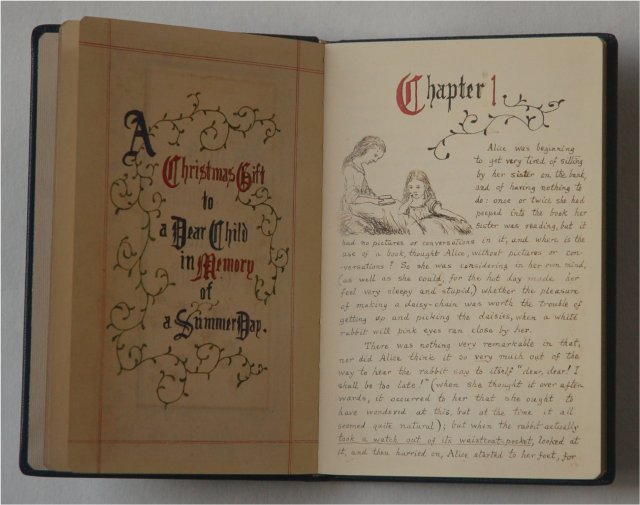
Almost everyone knows the children’s tale Alice in Wonderland by Lewis Carroll either having read the book, or seen or heard, one of the many adaptations over the years.  Most readers will know that Alice was a real person, one of the daughters of Henry Liddell, dean of Christ Church college at Oxford and the stories were told to entertain her and her sisters.  They will also know that Lewis Carroll was really the reverend Charles Lutwidge Dodgson, a 24 year old mathematics lecturer at Christ Church when he first met the Liddell’s. But what is less well known is that when the stories were first written down they were intended to just be a one off book as a gift to Alice and the title was Alice’s Adventures Under Ground.

20170116 The Original Alice 4

The book was handwritten and illustrated by Dodgson and was given to Alice for Christmas in 1864 when she was 12 years old, although he originally came up with most of the story when she was 10 on a trip up the river for a picnic. Alice treasured the little book for decades but eventually in 1928 at the age of 75 and now a widow needing money she sold it at auction for £15,000 (approximately £860,000 today). The book was bought by Dr Rosenbach, who was an American book dealer, and he subsequently sold it in the US.   The private collector who owned it died in 1948 and the book was again put up for auction this time making $50,000 (roughly $508,000 or £363,000 nowadays) and Dr Rosenbach was the top bidder at this auction as well.

20170116 The Original Alice 5

This time however was to be the last time it will ever come to the market. Several American benefactors led by book collector Lessing Rosenwald obtained the book in order to give it to Britain in thanks for the gallantry of the British people during the Second World War.  In November 1948 the book was brought on the liner The Queen Elizabeth across the Atlantic and presented to the British Museum with the Archbishop of Canterbury representing the country by receiving it.  The book is now part of the national collection (catalogue ref MS 45700).

In 1997 The British Library published a book by Sally Brown entitled The Original Alice, which now sadly out of print but fairly easy to find on the second hand market.  This tells the story of how Alice came to be written and compares Alice’s Adventures Under Ground to Alice in Wonderland with examples as to how the books differ.

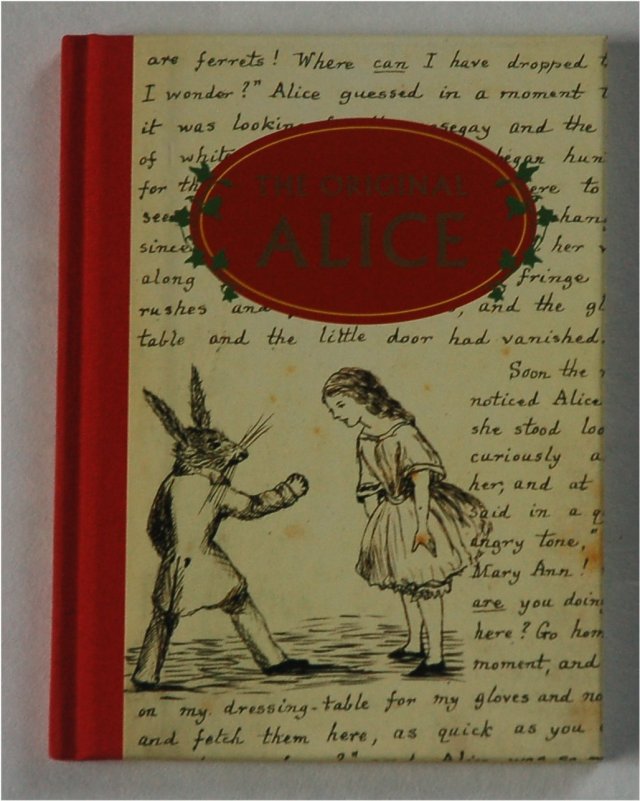
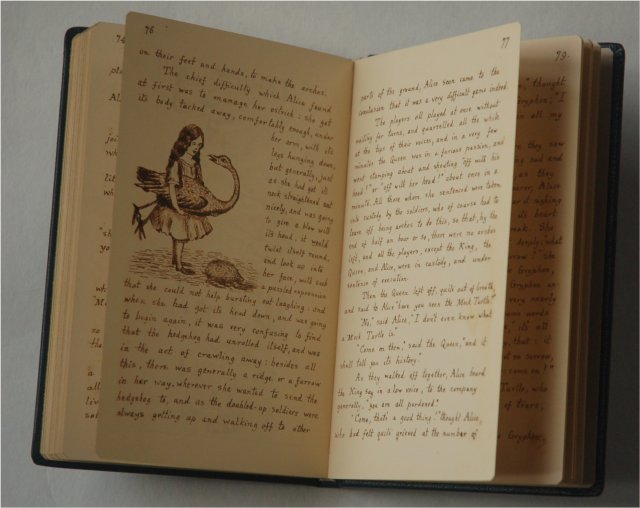
20170116 The Original Alice 1 The illustrations of the original book included here are from another out of print edition, a beautiful leather bound facsimile of the original produced in a limited edition run of just 3750 copies by the Folio Society in 2008, this is somewhat more tricky to track down but it is a beautiful thing to own and read.  It comes in a lovely box with a ribbon to lift the book out with.


Although he never intended publication Dodgson did pass the book to his friend, the children’s novelist George MacDonald, to cast his professional eye over, before giving it to Alice. MacDonald’s children so enjoyed the book that Dodgson was eventually persuaded to publish.  He significantly rewrote the tales, removing a lot of references that only really made sense to the Liddell family and adding Pig and Pepper along with The Mad Tea Party. These additions and revisions to the original text almost doubled the length and took the book up from 18000 to 35000 words.

Alice’s Adventures in Wonderland was finally published in November 1865 in an edition of 2000 copies but in a final twist these were withdrawn as the illustrator, John Tenniel, was unhappy with the quality of the reproductions of his pictures.  This makes the handful of copies that still exist one of the rarest of all children’s books.  The book was finally available to the public in 1866 and was an immediate success.  Alice’s Adventures Under Ground has been printed several times in the intervening 150 years but only the Folio Society have produced a true facsimile of the book with the leather binding and colour illustrations where appropriate, however it is worth searching out a copy of the text as first written as it gives a view of the story that Alice herself first heard and it is quite different to the text that we all know.

Welcome

1894 - Lane Christmas Book- The Life of Sir Thomas Bodley- 2 title pageWelcome to my book shelves, home to some 6500 volumes dating back to the mid 1700’s right up to the present day. I’m going to use these as the basis for short essays or reviews not just of these books but where ever they wish to take me.  The aim is to pick a book, or group of books each week and look at its significance, or just tell a tale as to why it has found itself here.

The Life of Sir Thomas Bodley featured with this first article is a good entry point as the Bodliean Library in Oxford takes its name from Sir Thomas who came to its rescue in the 1590’s and put it finally in the secure position it now holds as one of the worlds greatest libraries. So immediately we have a book leading to more books

When John Lane founded his publishing company in 1887 he chose to call it The Bodley Head in honour of Sir Thomas and for Christmas 1894 printed a very small number of copies of Bodley’s autobiography as gifts to friends and people who had helped set up the business.  Very few of these books have survived the intervening 123 years but it’s an interesting work that should perhaps be better known.

I have two copies of ‘The Life’ one still in the original card covers and one rebound in boards and this also includes the original compliments slip from John Lane.

My main interest in The Bodley Head however is in one of his employees in the 1930’s, Allen Lane, who went on to found a far more famous publishing company namely Penguin Books, which now owns The Bodley Head imprint and uses it for non-fiction titles.

Well over 2000 of my books are Penguins and I specialise in the first 10 years of the company 1935 to 1945 which led to some fascinating books and stories about how they came about as the firm struggled with wartime restrictions but also the greater need amongst the population at home and also servicemen/women for something to read.  More to come about those in future entries to this blog…