
The Garden – Vita Sackville-West

20180410 The Garden 8

Well the weather still isn’t admitting it’s spring, it’s pouring down with rain as I write this, but maybe this will give it a prod in the right direction. The winter seems to be hanging on way too long when it is definitely time to think of that jewel of English houses, the garden.

Bubbles of colour striking through the bleak
Dun soil, surprising in a week,
As the low desert flowers after rain
Leap into being where they were not seen
Few hours before and soon are gone again
So in our English garden comes the Greek
Blue wind-flow’r cousin of the meek
Bashful anemone of English woods,
As thick as shingle strewn on Chesil Beach;
So comes the Lady Tulip, with her streak
Of pink that ribs her white; and through the green
Of young fine grass, The Glory of the Snow,
So blue, a smear of fallen sky; come each
In quick succession as they grow and blow
In liberal April, host to little guests;

Vita Sackville-West was a poet, a novelist, a prolific letter writer, a lover, but above all else was a gardener and amongst her works one of the least well known but most evocative of that side of her is a short collection of verse entitled The Garden. My copy is the first edition from 1946 published by Michael Joseph, which I bought from the shop at Vita’s own garden Sissinghurst Castle in Kent now run by the National Trust. Although she would live until 1962 this was her final book of verse, with 11 volumes of poetry preceding it and indeed she only wrote 3 novels after 1946, out of the 17 she produced in total, as she gradually faded from literary fashion.

Nowadays if Vita is remembered at all it is for two things, her garden at Sissinghurst and her 10 year affair with Virginia Woolf which was the inspiration for Virginia’s best known novel Orlando. I will cover this aspect of her life more fully when I write about Orlando in a later blog. But it is sufficient to say here that although Vita was married to novelist and diplomat Harold Nicholson they both had several same-sex relationships during the marriage and her relationship with Virginia brought her into contact with The Bloomsbury Group although she never appeared to be comfortable there and never became an accepted member.

Her time with Virginia however was probably the peak of both of their literary output. Whether this was coincidence, or the result of their two personalities so strongly bonded feeding off each other for inspiration we will never know; but certainly Vita would never have this vitality in her work again and Virginia although still as successful after they split had written her best by 1935 when they parted.

This slideshow requires JavaScript.

As for this work, the book has 5 separate but linked poems, The Garden, Winter, Spring, Summer, Autumn. The verse quoted above is from Spring and as suggested by the titles we progress through the year from winter planning…

                                                    – so in Winter
The Gardener sees what he will never see

Here, in his lamp-lit parable, he’ll scan
Catalogues bright with colour and with hope,
Dearest delusions of creative mind,
His lamp-lit walls, his lamp-lit table painting
Fabulous flowers flung as he desires.
Fantastic, tossed, and all from shilling packet
-An acre sprung from one expended coin,-
Visions of what might be.
We dream our dreams.
What should we be, without our fabulous flowers?
The gardener dreams his special own alloy
Of possible and the impossible.

The dreams of what will come after the cold and rain of winter has been banished lead on to awakening buds and early flowers in the quote from spring to summer where Vita clearly has a wasp problem, or at least a problem with wasps as there are 2 or 3 pages of verse complaining about them whilst enjoying the fruits of her labours. Oddly although Vita, rather than Harold, was the gardener of the two the poems always refer to ‘The Gardener’ as a man whenever a gender is required in the text.

But then in Autumn we find the gardener busy again

But in October, later, shall you stand
With paper sack of bulbs and plunge your hand
And carelessly fling your bulbs both large and small
To roll, to topple, settling sparse or thick,
Over the grass, and plant them where they fall,
(Legitimate device, a sanctioned trick,)
Thus in a drift as though by nature planned
Snowdrops shall blow in spreading tide,
Little white horses breaking on the strand
At edge of orchard; and the orange-eyed
Narcissus of the poets in a wide
Lyrical river flowing as you pass
Meandering along the path of grass

As for Vita’s actual garden it is presented as a series of ‘rooms’ each with their own theme, these are separated by hedgerows or walls and each allows for a glimpse into one or two adjacent rooms through carefully placed gaps. The division of the design between Vita and Harold appears to be that he came up with the rooms and the network of interconnects and Vita filled them with flowers to make best use of the deliberately restricted views out of each one. Fortunately it is possible to go high up one of the towers and look down on the patchwork to appreciate how cleverly the structure is put together and at ground level you are constantly getting glimpses of new vistas whilst being able to concentrate on the theme of the room you are in due to the clear boundaries imposed. The formal gardens are roughly 4 hectares (almost 10 acres) in size and are 1 of 145 Grade 1 listed gardens and parks in England. They were largely laid out through the 1930’s with the exception of the famous ‘white garden’ which was created after the war to replace a rose garden from the original plan. There is an excellent description of the entire garden in the Historic England listing for Sissinghurst. This compartmentalised structure to the garden is mirrored in the way the book is produced with what is basically one long poem split into the seasonal sections and preceded by the section just called The Garden which is the subject of this final quote

Much toil, much care, much love and many years
Went to the slow reward; a grudging soil
Enriched or lightened following its needs;
Potash and compost, stable dung, blood, bones,
Spent hops in jade-green sacks, the auburn leaves
Rotted and rich, the wood-ash from the hearth
For sticky clay; all to a second use
Turned in a natural economy,
And many a robin perched on many a sod
Watched double-trenching for his benefit
Through the companionable russet days,
But only knew the digger turned the worm
For him, and had no foresight of the frost
Later to serve the digger and his clod
Through winter months, for limitations rule
Robins and men about their worms and wars,
The robin’s territory; and man’s God.

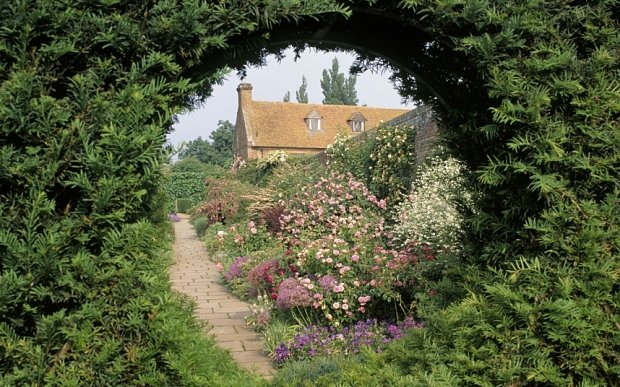
I visited Sissinghurst many times when I lived in Kent and somewhere I have a box of photos I have taken there, but until I find and scan them a few of some other peoples shots will have to do to illustrate the work of a poet and artist of flowers. I first read this book of poetry in Vita’s own garden and it will always transport me back to warm summer days in the Garden of England in the late 1990’s.

20180410 The Garden 1


20180410 The Garden 2


20180410 The Garden 3


20180410 The Garden 4


20180410 The Garden 5

The Devil’s Dictionary

20180327 Devil's Dictionary

Although now recognised as an American classic The Devil’s Dictionary by Ambrose Bierce was never originally intended to even become a book and certainly not intended to be read like one. It is, as the title implies, a dictionary; but full of alternative definitions, normally humorous, often satirical and sometimes it has to be said just plain strange at least to modern readers. But before looking at the book itself it is a good idea to know something about Bierce himself and how it came to be written and that is not as simple a task as it sounds as implied by the first sentence of the book summary in my copy.

The life of Ambrose Bierce is a tissue of facts embroidered with legend.

Normally at least birth and death dates of a well known journalist and author such as Ambrose Bierce would at least be known but although we know that he was born in 1842 the best that can be done for his death is ‘probably 1914’ when he went to Mexico during the revolution and was never heard of again.

But lets backtrack over what is known. In 1861 he enlisted in the 9th Indiana Infantry and fought in the American Civil War apparently with distinction and it was thought that he would go to a military academy after the war and make that his career but he was already interested in writing. So in 1866 he apparently ‘tossed a coin to decide whether to stay in the army or become a journalist. Journalism won the toss.’ By this time his army career had brought him to San Francisco, and that is where he started to teach himself what he needed to know; and started writing pieces some of which made it to print. In 1868 he got his first regular journalistic job and in a roundabout way this was to lead to the book I have. The job wasn’t journalism as such in that it didn’t involve factual reporting of news, instead it was a page in the San Francisco News Letter entitled ‘Town Crier’ which was a humorous and satirical view of life in the city and Bierce was set on his path to fame. He would over much of the rest of his life continue to write satire for numerous publications and by 1869 he had included his first multiple definition entry of what would eventually be a book although at the time it was probably just a useful space filler for the Town Crier page.

Over the ensuing thirty plus years Bierce continued his definitions in his various columns in publications not just in America but also in England where he lived for 3½ years in the 1870’s. They became increasingly popular and also much copied with Bierce sometimes entitling them The Devil’s Dictionary or later on The Cynic’s Dictionary until the idea of combining them into a book came to him in 1903. By the time of publication however not only had his idea been stolen but even the title of his column had been used by a competitor to publish their own set of definitions so he was forced to use the title The Cynic’s Word Book when it came out in 1906. Oddly it only included 521 definitions for the letters A to L with an intention to have a second volume covering M to Z later on, however it didn’t sell well enough for this plan to be realised.

And so it stayed as an unfinished work until 1911 when Bierce was working on his collected works and volume 7 was entitled The Devil’s Dictionary, this time covering the entire alphabet and with 1000 definitions, some of which were specially written for the book especially at the end of the alphabet because over all of his columns Bierce had only reached the word shoddy.

Shoddy: n. (vulgus) A term that expresses the status of a large part of our society, and furnishes a weakly page of matter to many of our time-serving dailies.

*Weakly is as written and implies a certain disdain for many of his less talented rivals producing similar columns for other newspapers.

The collected works was also a financial failure but The Devils Dictionary was recognised as probably his finest work and after his death went on to be published as a standalone volume by several companies and establish itself as a major work of American humour.

We then leap forward to 1963 when Ernest Jerome Hopkins, after a long career as a journalist, became Professor Emeritus of Journalism at Arizona State University and after discovering that the title didn’t actually come with any specific work decided to have another look at The Devils Dictionary and some strange gaps in the words chosen. It rapidly became clear that by no means all of the definitions Bierce had written for his various columns had made it into the published book, almost certainly because at the time of compiling he had been living on the Eastern seaboard of America and a lot of the early material was 3000 miles away in California and no copies would have existed in reference libraries where he was. Over the next few years Hopkins unearthed a further 851 definitions left out of the 1911 book and in 1967 the Enlarged Dictionary was published. My copy is the Penguin Classics edition, first issued under this imprint in 1985 although Penguin printed their first edition in 1971 in their main series.

To conclude let’s have a few definitions taken at random from the book, I have literally just opened the book and picked a word for each of these so it should give a flavour of the work as a whole, some are funny, some are sharp and some are odd, I’ll let you decide which are which. In the case of long definitions I have just included the first part, some go on a lot longer than others.

Edible: adj. Good to eat and wholesome to digest, as a worm to a toad, a toad to a snake, a snake to a pig, a pig to a man, and a man to a worm.


Bald: adj. Destitute of hair from hereditary or accidental causes – never from age.


Riddle: n. Who elects our rulers?


Miss: n. A title with which we brand unmarried women to indicate that they are in the market.


Insurance: n. An ingenious modern game of chance in which the player is permitted to enjoy the comfortable conviction that he is beating the man who keeps the table.


Dice: n. Small polka-dotted cubes of ivory, constructed like a lawyer to lie on any side, but commonly on the wrong one.


Fauna: n. A general name for the various beasts infesting any locality exclusive of domestic animals, travelling menageries and Democratic politicians.


Road: n. A strip of land along which one may pass from where it is too tiresome to be to where it is futile to go.

Robert Hooke’s Micrographia

2nd January 1666

Thence to my bookseller’s and at his binders saw Hookes book of the Microscope which is so pretty that I presently bespoke it.

20th January 1666

so to my bookseller’s and there took home Hookes book of Microscopy, a most excellent piece, and of which I am very proud.

21st January 1666

Before I went to bed I sat up till 2 a-clock, in my chamber reading of Mr Hookes Microscopicall Observations, the most ingenious book that ever I read in my life.

I have to agree with Samuel Pepys, I have added this book to my library in the last week and like the celebrated diarist I have spent hours late into the night reading and looking at the wonderful illustrations. It is hard to imagine just how revolutionary a work it was in it’s time, nobody had seen anything like it before. Very few people had access to a microscope and very little had been printed with illustrations of what you could see with the use of one. Micrographia was the first book published by The Royal Society, just three years after the society had been granted it’s royal charter in 1662 making it the oldest scientific academy in the world. Pepys had become a fellow of the society on 16th February 1665 so knew Hooke and would have been well aware of the book before publication.

Now it may seem odd to write a review of a book that came out over 350 years ago but the edition published by The Folio Society is the first high quality version printed in the last 200 years and reproduces in full size the original plates including large fold out pages that are up to 2 feet (60cm) across. The book is consequently large at 13½” × 8¾” (34.3cm x 22.2cm) and quarter bound in leather. The cover is printed on cloth and based on the eye of a grey drone fly and was designed by Neil Gower.

20180305 Micrographia 1

Inside the illustrations are the first thing to catch your eye but then the text pulls you in. Although this is primarily an important, and in its time ground breaking, scientific work Hooke wrote for the interested layman and even after all these centuries it is still an engaging story. Instead of just describing the illustrations he explains why and how he came to look at them in the first place, you get his first impressions and you can share in his sense of wonder at what is revealed.

20180305 Micrographia 2

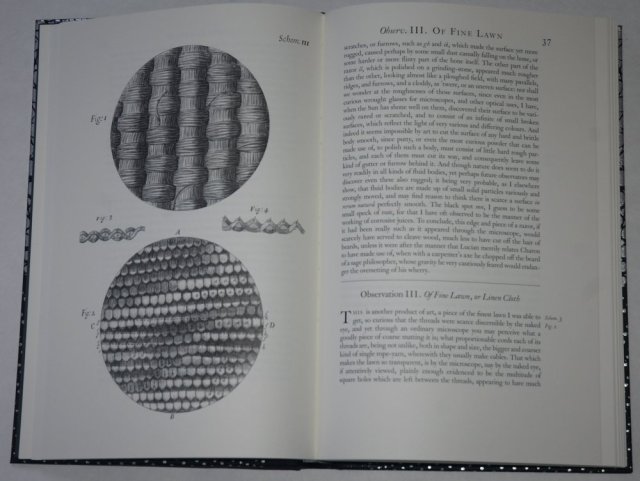
A study of a piece of cloth to reveal the weave, the end of a pencil, a needle, nothing is beyond his inquiring mind and everything he looked at and wrote about was new to the reader who would not have had access to anything like this before.

20180305 Micrographia 3

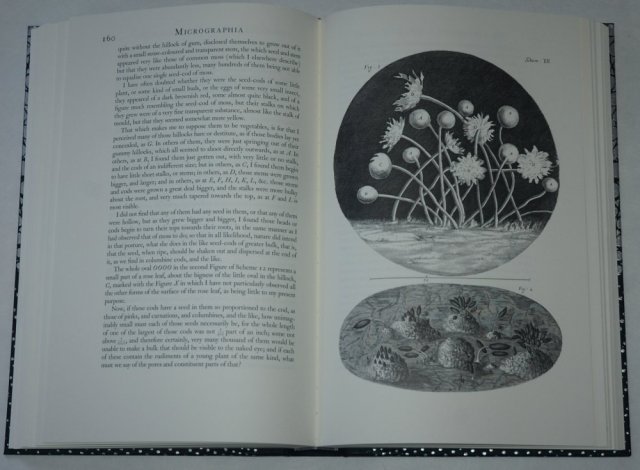
The picture above is of the black spots on the leaves of the rose bushes in his garden. To his surprise these turned out to be ‘tiny plants’ growing on the leaves themselves. Nowadays we understand what he is looking at but the text explains his reasoning that this is some sort of mould and the next thing he then examines is a blue mould on a book bound in leather from a sheep to see if his premise is valid. You learn with Hooke and it’s no surprise that Pepys found the book so fascinating.

20180305 Micrographia 4

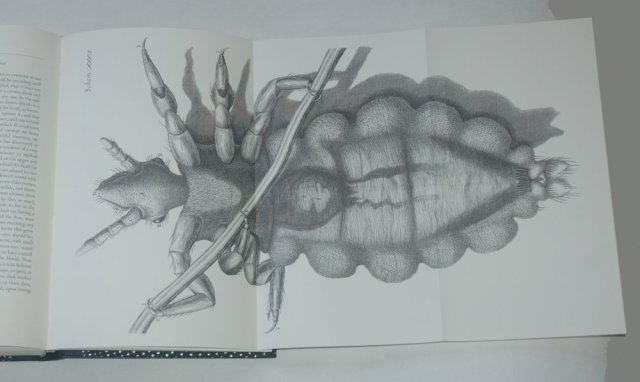
The large fold out plates are possibly the most famous pictures in the book and The Folio Society have reproduced pages from original 1st and 2nd editions (whichever were the best examples) held in the Bodleian Library in Oxford. There is also a small section at the end where Hooke turns his attention away from the very small to the very large and includes some observations he made with a telescope including an early map of part of the moon.

20180305 Micrographia 5

It really is a joy to own and read this book, which was published in 2017 in a limited edition of just 750 copies, mine is number 635. Whilst I love the normal production of The Folio Society and have over 400 books printed by them; it is their limited editions that are their crowning glory. Printed on the finest paper and treated as a work of art in their own right these books are rightly regarded as something special and Micrographia was the winner of the “Scholarly, Academic and Reference Book” category at The British Book Design & Production Awards 2017. A fantastic addition to any library.

There is a video of the book from The Folio Society on YouTube which  gives a better idea as to the size and beauty of this amazing work and this makes an interesting comparison to a video from The Bodleian Library about their first edition.


Norse Mythology – Neil Gaiman

20170206 Norse mythology 1

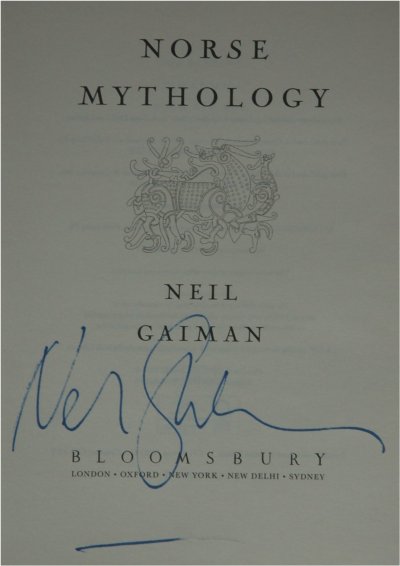
Neil Gaiman’s Norse Mythology is a retelling of the Old Norse myths in a straightforward style aimed at the young adult market. He begins with a brief introduction to Odin, Thor and Loki and then the other characters that populate the myths are explained as we meet them.  The book has had a small number of poor reviews on Amazon, but mainly by people who were expecting a Neil Gaiman story rather than an introduction to the Norse mythology and were therefore disappointed not to find one. For me however it took me back to my childhood in the 1960’s and 70’s reading childrens’ magazines such as Look and Learn and World of Wonder, both of which regularly dipped into mythologies from around the world for features or retellings.

The dustwrapper is beautiful, featuring Thor’s hammer Mjollnir against a background of stars but how many people have taken this off to find the hammer again on the cover of the book

20170206 Norse mythology 2

There are 15 tales included, ranging in length from 3 to 23 pages, so this can be dipped into as a quick read over a period of a few days, but equally it doesn’t take long to read the whole thing. They are easily approachable, avoiding the temptation to explain everything with additional notes which can be a failing in editions aimed at adults which can fall into a scholastic tone. As Neil himself says in his introduction

As I retold these myths, I tried to imagine myself a long time ago, where the stories were first told, during the long winter nights perhaps, under the glow of the Northern Lights, or sitting outside in the small hours, awake in the unending daylight of midsummer, with an audience of people who wanted to know what else Thor did, and what the rainbow was, and how to live their lives, and where bad poetry comes from.

And that I think is the essence of Neil’s book, they feel like they are tales as told to an audience rather than pinned to the page like a specimen butterfly, they have a narrative flow and it doesn’t matter that Yggdrasil and the nine worlds is only 3 pages long, it tells you what you need to know and that information will illuminate later tales.

The book is of course just a brief introduction to the huge body of Norse tales and it would be nice to think that readers today will be inspired, as I was all those years ago with the magazines, to explore further and then maybe try some of the Icelandic sagas which I have enjoyed over the intervening years. More of those I think in a later blog. So thank you Neil for reminding me of the pleasure I got when I first encountered the Norse myths when I was 6 or 7 years old and the joy they still give me.

20170206 Norse mythology 3

Footnote: I thought the UK hardback cover was beautiful and then saw the American paperback due out next month…

20170206 Norse mythology 4

The Diary of a Bookseller – Shaun Bythell

For my entry this week I’ve decided to review a book I was given at Christmas and thoroughly enjoyed, The Diary of a Bookseller by Shaun Bythell.

20170123 The Diary of a Bookseller

Shaun is the notoriously curmudgeonly owner of the largest second hand bookshop in the Scotland which goes by the wonderfully simple name of The Bookshop. Not The Wigtown Bookshop (which is where it is) or Bythells’ Books, no it’s just The Bookshop, direct and to the point just like its owner. His website name is similarly one to be envied by anyone in the trade www.the-bookshop.com. The book takes a very simple starting point “to write things down as they happened in the shop” and develops into an entertaining story of how a year passed for Shaun and his equally eccentric staff.  It starts randomly on Wednesday 5th February 2014 and finishes on Wednesday 4th February 2015 (this entry is as far as I can remember the only time the year is specified).

As the owner of a specialist retail business in a small town myself the interactions with customers, or at least people who wander into the shop, move stock around and then leave without buying anything, that Shaun documents are all to familiar.

Tuesday 8th April

At 10:15am a woman walked in and roared, I am in my element! Books! then continued to shout questions at me for an hour whilst she waddled about the shop like a ‘stately goose’ as Gogol describes Sobakevich’s wife in Dead Souls. Predictably she didn’t buy anything.

Few things are more guaranteed than when somebody you have never seen before in the shop and expresses huge enthusiasm on entering is that they won’t buy anything.

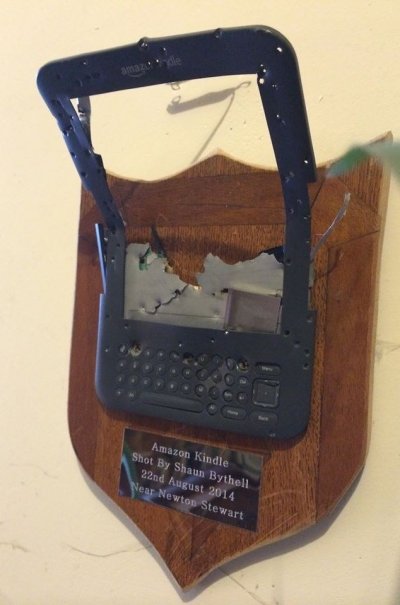
Shaun also has a dislike, no that’s the wrong word, hatred would be better, of Kindles and this is referred to several times in the book even to the point of shooting one and mounting the remains on the wall in his shop like a hunting trophy.

20170123 The Diary of a Bookseller 2

This is totally understandable for somebody who makes their living selling books (well maybe not the shooting part) you can’t after all trade the contents of a Kindle but as somebody who loves books I also dislike the impersonal nature of reading on a screen. I found the photo on pinterest so don’t know who originally took it so I apologise in advance for unacknowledged copyright.

However I don’t want to give the idea that the book is just full of Shaun complaining, sometimes he is having a great time, although usually this is whilst he isn’t actually in the shop. Wigtown is Scotlands’ book town, based on the idea by Richard Booth in Hay on Wye, gathering bookshops together to make the place a specific destination for book lovers all over the world and The Bookshop was the first of what is now 13 independent retailers in the town.  It is also home to a book festival at the end of September which is documented in the book.  The Bookshop hosts ‘The Writers Retreat’ a place where guest speakers at the festival can escape to good food and drink and to chat amongst themselves and this leads to more stories being told. There is clearly a lot of effort put into the festival and I really ought to go, but maybe not this year as I suspect a lot of readers of this book have had the same idea.

Tuesday 25th March

Shortly after Andrew had left an extremely rude old woman demanded a copy of Simon Sebag Montefiore’s biography of Stalin. We had one in the Russia section which she brought to the counter. It was an unusually pristine copy in a mint jacket, clearly unread – original price £25. She asked how much it was, I pointed to the sticker that says £6.50. She pushed it away from her and turned; walking out muttering, ‘Too expensive’. I’m pretty sure she’ll be back so I re-priced it at £8.50.

I loved the book and can’t recommend it more, you don’t have to be a bookseller or even a shopkeeper of any sort to get a lot of pleasure from it.

By the way I checked and yes you can get it on Kindle, Shaun is presumably furious…