Well the weather still isn’t admitting it’s spring, it’s pouring down with rain as I write this, but maybe this will give it a prod in the right direction. The winter seems to be hanging on way too long when it is definitely time to think of that jewel of English houses, the garden.
Bubbles of colour striking through the bleak
Dun soil, surprising in a week,
As the low desert flowers after rain
Leap into being where they were not seen
Few hours before and soon are gone again
So in our English garden comes the Greek
Blue wind-flow’r cousin of the meek
Bashful anemone of English woods,
As thick as shingle strewn on Chesil Beach;
So comes the Lady Tulip, with her streak
Of pink that ribs her white; and through the green
Of young fine grass, The Glory of the Snow,
So blue, a smear of fallen sky; come each
In quick succession as they grow and blow
In liberal April, host to little guests;
Vita Sackville-West was a poet, a novelist, a prolific letter writer, a lover, but above all else was a gardener and amongst her works one of the least well known but most evocative of that side of her is a short collection of verse entitled The Garden. My copy is the first edition from 1946 published by Michael Joseph, which I bought from the shop at Vita’s own garden Sissinghurst Castle in Kent now run by the National Trust. Although she would live until 1962 this was her final book of verse, with 11 volumes of poetry preceding it and indeed she only wrote 3 novels after 1946, out of the 17 she produced in total, as she gradually faded from literary fashion.


Nowadays if Vita is remembered at all it is for two things, her garden at Sissinghurst and her 10 year affair with Virginia Woolf which was the inspiration for Virginia’s best known novel Orlando. I will cover this aspect of her life more fully when I write about Orlando in a later blog. But it is sufficient to say here that although Vita was married to novelist and diplomat Harold Nicholson they both had several same-sex relationships during the marriage and her relationship with Virginia brought her into contact with The Bloomsbury Group although she never appeared to be comfortable there and never became an accepted member.
Her time with Virginia however was probably the peak of both of their literary output. Whether this was coincidence, or the result of their two personalities so strongly bonded feeding off each other for inspiration we will never know; but certainly Vita would never have this vitality in her work again and Virginia although still as successful after they split had written her best by 1935 when they parted.
As for this work, the book has 5 separate but linked poems, The Garden, Winter, Spring, Summer, Autumn. The verse quoted above is from Spring and as suggested by the titles we progress through the year from winter planning…
– so in Winter
The Gardener sees what he will never seeHere, in his lamp-lit parable, he’ll scan
Catalogues bright with colour and with hope,
Dearest delusions of creative mind,
His lamp-lit walls, his lamp-lit table painting
Fabulous flowers flung as he desires.
Fantastic, tossed, and all from shilling packet
-An acre sprung from one expended coin,-
Visions of what might be.
We dream our dreams.
What should we be, without our fabulous flowers?
The gardener dreams his special own alloy
Of possible and the impossible.
The dreams of what will come after the cold and rain of winter has been banished lead on to awakening buds and early flowers in the quote from spring to summer where Vita clearly has a wasp problem, or at least a problem with wasps as there are 2 or 3 pages of verse complaining about them whilst enjoying the fruits of her labours. Oddly although Vita, rather than Harold, was the gardener of the two the poems always refer to ‘The Gardener’ as a man whenever a gender is required in the text.
But then in Autumn we find the gardener busy again
But in October, later, shall you stand
With paper sack of bulbs and plunge your hand
And carelessly fling your bulbs both large and small
To roll, to topple, settling sparse or thick,
Over the grass, and plant them where they fall,
(Legitimate device, a sanctioned trick,)
Thus in a drift as though by nature planned
Snowdrops shall blow in spreading tide,
Little white horses breaking on the strand
At edge of orchard; and the orange-eyed
Narcissus of the poets in a wide
Lyrical river flowing as you pass
Meandering along the path of grass
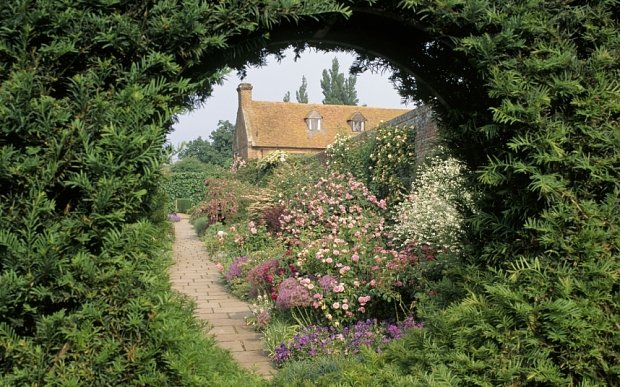
As for Vita’s actual garden it is presented as a series of ‘rooms’ each with their own theme, these are separated by hedgerows or walls and each allows for a glimpse into one or two adjacent rooms through carefully placed gaps. The division of the design between Vita and Harold appears to be that he came up with the rooms and the network of interconnects and Vita filled them with flowers to make best use of the deliberately restricted views out of each one. Fortunately it is possible to go high up one of the towers and look down on the patchwork to appreciate how cleverly the structure is put together and at ground level you are constantly getting glimpses of new vistas whilst being able to concentrate on the theme of the room you are in due to the clear boundaries imposed. The formal gardens are roughly 4 hectares (almost 10 acres) in size and are 1 of 145 Grade 1 listed gardens and parks in England. They were largely laid out through the 1930’s with the exception of the famous ‘white garden’ which was created after the war to replace a rose garden from the original plan. There is an excellent description of the entire garden in the Historic England listing for Sissinghurst. This compartmentalised structure to the garden is mirrored in the way the book is produced with what is basically one long poem split into the seasonal sections and preceded by the section just called The Garden which is the subject of this final quote
Much toil, much care, much love and many years
Went to the slow reward; a grudging soil
Enriched or lightened following its needs;
Potash and compost, stable dung, blood, bones,
Spent hops in jade-green sacks, the auburn leaves
Rotted and rich, the wood-ash from the hearth
For sticky clay; all to a second use
Turned in a natural economy,
And many a robin perched on many a sod
Watched double-trenching for his benefit
Through the companionable russet days,
But only knew the digger turned the worm
For him, and had no foresight of the frost
Later to serve the digger and his clod
Through winter months, for limitations rule
Robins and men about their worms and wars,
The robin’s territory; and man’s God.
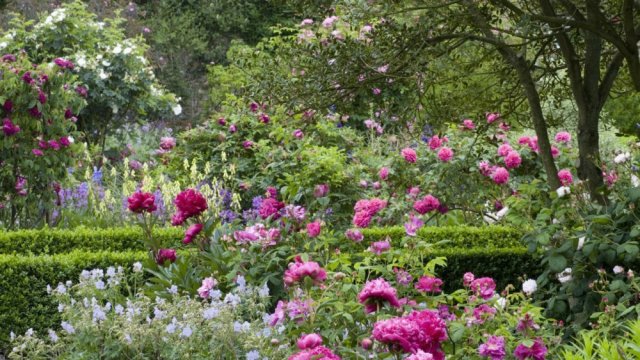
I visited Sissinghurst many times when I lived in Kent and somewhere I have a box of photos I have taken there, but until I find and scan them a few of some other peoples shots will have to do to illustrate the work of a poet and artist of flowers. I first read this book of poetry in Vita’s own garden and it will always transport me back to warm summer days in the Garden of England in the late 1990’s.