War – Sebastian Faulks

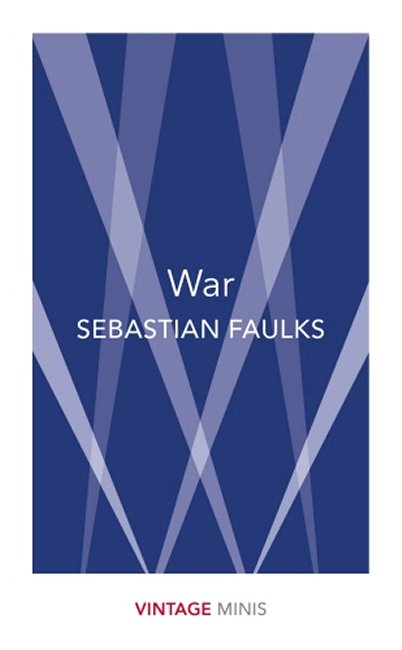
I mentioned on last weeks blog that the Agatha Christie didn’t last the week in Belgium however I did have a backup, although it turned out not to be as expected. I spotted War by Sebastian Faulks in a bookshop just before I left and thought it would be appropriate as I was based in Ypres for the week so surrounded by battlefields and cemeteries for the war dead of, mainly, combatants of World War One. I’ve been meaning to read something by Faulks for some time as his reputation led me to expect great things and I wasn’t to be disappointed in that regard. But if I had looked more closely I probably wouldn’t have bought this book as it turned out to be extracts from three of his novels, ‘Birdsong’, ‘Where My Heart Used to Beat’ and ‘A Week in December’ but at least it gave me a chance to try his works, which is presumably the idea. The books cover three different periods, ‘Birdsong’ is set during World War One, ‘Where My Heart Used to Beat’ is World War Two and ‘A Week in December’ is modern times Muslim jihad terrorism in London.

Let’s start with ‘Birdsong’, the extract is forty five pages of an over five hundred page work first published in 1994 and whilst the novel focuses on, Stephen Wraysford, a young officer in the Great War, the extract in ‘War’ deals largely with Private Jack Firebrace, an ex miner who is tunnelling out from the trenches through no man’s land to undermine or bomb the German positions. This is of course extremely dangerous, not just from possible collapse of the damp soil but from enemy shelling and the ever present possibilities of meeting German’s coming the other way. The book is wonderfully written, it’s no surprise to discover that it is probably Faulk’s best known work as the extract drew me in to the claustrophobic existence of the tunnellers and the awful conditions in the trenches. The first paragraph of the extract gives a feel for the novel:

JACK FIREBRACE lay forty-five feet underground, with several hundred thousand tons of France above his face. He could hear the wooden wheezing of the the feed that pumped air through the tunnel. Most of it was exhausted by the time it reached him. His back was supported by a wooden cross, his feet against the clay, facing towards the enemy. With an adapted spade, he loosened quantities of soil into a bag which he passed back to Evans, his mate, who then crawled away in the darkness. Jack could hear the hammering of timbers being used to shore up the tunnel further back, though where he worked, at the face, there was no guarantee that the clay would hold.

After a hard days digging Jack was expecting a rest but was put on guard duty instead due to shortage of men. However exhaustion overtook him and he fell asleep where he was discovered and condemned to be shot at dawn for desertion of duty such was the black and white horror of World War One.

The extract that follows from ‘Where My Heart Used to Beat’ is fifty eight pages from three hundred and fifty so more representative and roughly a sixth of the entire original book, which first appeared in 2016. The action in the extract takes a first person narrative of a newly commissioned officer during World War Two who is part of the British Expeditionary Force, that strange time before it was known as the British army in WWII and is forced to retreat to Dunkirk for the great small boats rescue. On his way specifically mentioning passing through Poperinge, just a few miles from where I was sitting in Ypres reading the book and where we had been the day before. This sudden intrusion into my modern experience was remarkably evocative as I imagined the hardship of the troops passing through the now lovely fields in this part of Flanders. Again it is beautifully written and when the unit are back in combat, this time fighting their way through Italy to Monte Cassino in the push to get the Germans out of Italy you really feel you are alongside the men as you are totally pulled into the narrative.

The third extract from ‘A Week in December’ is just twenty eight pages out of four hundred and the book was first published in 2009 but set in December 2007. The book itself is a satirical dealing with the money men of the City of London that were about to pull everything down in the great financial crash of 2008 and focuses on seven characters with the main one being the hedge fund manager John Veals. However the extract doesn’t mention him of five of the others being instead the story of Hassan al-Rashid whose Muslim faith has got him involved in extremism to the point that he agrees to be part of a bombing of a London hospital. I’m intrigued how this fits into the entire work so I’ll almost certainly have to read the full book at some point but of the three ‘Birdsong’ is top of my list to search out closely followed by ‘Where My Heart Used to Beat’, I definitely need to read more Sebastian Faulks.

A Farewell to Arms – Ernest Hemingway

Book number two from Penguin Books’ first ten titles which I’m reading in the quite fragile first edition copies to mark their ninetieth anniversary is A Farewell to Arms. As mentioned in last week’s blog about Ariel all the original rear covers for these books refer to this book as Farewell to Arms but this was quickly noticed and corrected and after the initial distributed batch the ‘A’ was reinstated. I’ve never been a particular fan of Hemingway, but I have enjoyed this, his second novel, which is based quite heavily on his own experiences in Italy during WWI although with fictional military units and characters some of which are based on real people. It was first published in 1929 and was sandwiched between his first novel ‘The Sun Also Rises’ and a non fiction book ‘Death in the Afternoon’ both of which are concerned with bullfighting which was a passion of his and probably negatively coloured my original impression of Hemingway.

The book follows American volunteer Frederic Henry who is serving as a Lieutenant in an ambulance corps for the Italian army before the Americans actually joined WWI. He meets an English nurse named Catherine Barkley but is rebuffed when he tries to kiss her. Later Henry gets badly injured in one knee during a mortar attack on the front line, getting decorated for his bravery in assisting fellow soldiers and ends up being looked after for months in a hospital in Milan where he is treated by Catherine and a relationship develops. I don’t know why but I wasn’t expecting a romantic story from Hemingway and this it definitely is as the deepening love between Frank and Catherine during his recovery supersedes the war driven plot in the first section of the book. Only for the war to come back into the story as Frank recovers sufficiently to be posted back to the front just in time for the Italian army to retreat in the face of German onslaught. Later whilst hiding as a civilian he joins up again with the now pregnant Catherine and they make an escape to Switzerland.

Hemingway on the other hand arrived in Italy in June 1918, aged just eighteen, as a Second Lieutenant working as an ambulance driver. In July he was injured in a mortar attack and got decorated and promoted to Lieutenant for his bravery in assisting fellow soldiers and then ended up spending six months recuperating in a hospital in Milan where he met an American nurse named Agnes Von Kurowsky and fell in love with her. Rather than go to Switzerland to escape the war in reality the conflict finished whilst he was being treated and he went back to America in early 1919 expecting Agnes to join him later. Instead she got engaged to an Italian officer and the two never met again.

That Hemingway had first hand experiences of the scenarios depicted in the novel is obvious in the vivid descriptions both of the conflict and the life in Milan during Frank’s recuperation, which at times seems so far away from the realities at the end of the First World War. The book is written in the first person from the point of view of Frank and I was particularly drawn in by the later sections covering the retreat from the north where Frank and his crew were as likely to be shot by jumpy and trigger happy Italians as the advancing Germans. The text is accurate enough for me to follow their movements on a map of northern Italy and then his escape from actually being shot by a group of disaffected Italian lower ranks and Carabinieri because he is an officer leading to his abandonment of his uniform to avoid reprisals through to the ultimate night time row across the Swiss border.

Below is a photo of my first edition copies of the first ten Penguin titles issued together on 30th July 1935.

The Dark Invader – Captain Von Rintelen

The first Penguin books were published in July 1935 and introduced their distinctive colour coding by subject category, a scheme copied from the Albatross Books in Europe. Initially there was just orange for fiction, dark blue for biography and green for crime but gradually more categories and colours were added including the first cerise for travel and adventure in September 1936. This is that first title and tells in his own words the story of how German WWI spy and saboteur Captain Von Rintelen operated in America for a few short months in 1915 and what happened to him afterwards. It may be thought of as an odd book to be publishing so close to WWII but presumably it was seen as an object lesson for possible activity if Germany did indeed start war again.

Rintelen was chosen from the German Naval Command to go to America to try to stop munitions being shipped to the the Allies. The latest American shells were made from steel rather than the inferior iron still utilised in Europe so were far more destructive, America was still neutral in the conflict so Germany had at first tried to stop America supplying weapons at all as they were seen as taking sides but America then offered to supply Germany as well knowing full well that the British blockade of German shipping routes meant that such a trade was impossible. The only option to the Germans was therefore to stop the ships somehow and Rintelen was just the man, he spoke English fluently and apparently had no problem passing as either English or American and had proved his resourcefulness already in transferring five million marks worth of gold by train and lorry from Berlin to Constantinople to pay bills for the cruisers Goeben and Breslau as German paper money wasn’t being accepted. Rintelen travelled to America via Denmark using papers describing him as a Swiss merchant but once there found that the contact he had arranged had not turned up so he had to start from nothing in the way of a plan but at least he had three million dollars which he had managed to transfer to American banks via various circuitous routes.

Rintelen was to be in America for just four months but in that time managed to do an amazing number of things from arranging manufacture and distribution on board ships of incendiary devices timed to go off during the Atlantic crossing to gaining the contract to supply Russia with wartime supplies none of which made it due to the ships being planted with the devices but which significantly added to the his coffers due to being paid at loading. He also formed a union of dock workers which came out on strike thereby preventing further ships being loaded and ultimately discussed with the deposed president of Mexico starting an uprising with an invasion of America to regain Arizona and therefore directing munitions to an America/Mexico war rather than Europe. That he managed to do so much in so little time and caused major disruption to military supplies across the Atlantic was a tribute to his resourcefulness, that he managed to also largely deflect suspicion from himself was remarkable. However his superiors were not so careful and intercepted telegrams in a code the Allies had access to led to his downfall.

Recalled to Germany, supposedly to review progress and adjust plans Rintenlen was intercepted in his Swiss guise by the British and interned in reasonable luxury at a camp for officers before being transferred to America where he spent four years in a regular prison for actions carried out whilst America was neutral so he wasn’t recognised as a prisoner of war. All this is covered in the book with surprising insights into how well he was treated by the British as opposed to the Americans. The book finishes with him returning to Germany in 1921 as a largely forgotten man. Rintelen came back to Britain in 1933 as he despised Hitler and he lived here until his death in 1949.

This book, along with the sequel ‘The Return of the Dark Invader’ (not published by Penguin) went out of print around 1941/2 when books about the cleverness of German spies ceased to be of interest to the general public and both books stayed out of print for decades. I have found ‘The Dark Invader’ published in 1998 by Frank Cass under their Classics of Espionage series. Apart from that if you want to read this book, and I do recommend it not only for its historical interest but because it is very well written, then you need to hunt down an eighty to ninety year old copy. Fortunately it is surprisingly easy to find them and it shouldn’t cost much more than £10 for a Penguin.