Puffin Story Books – the beginning

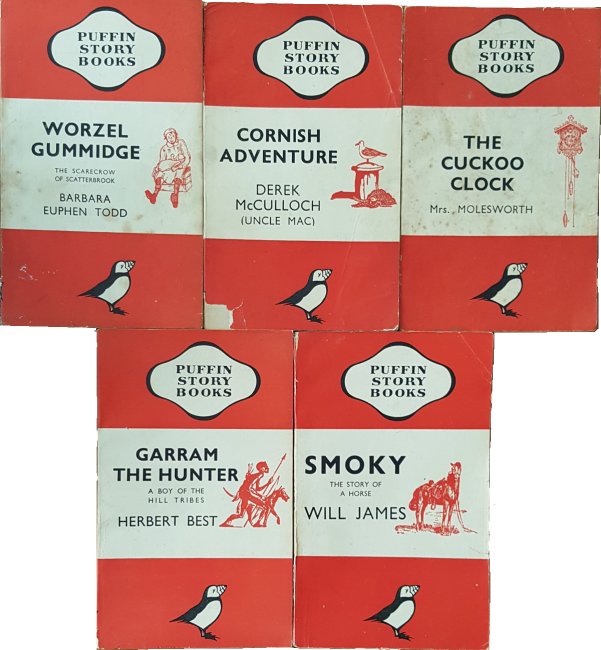
I somehow missed the eightieth anniversary of the start of Puffin Books last month as they launched in December 1941 but let’s somewhat belatedly look at how this massively important children’s imprint from Penguin Books started with five books, Worzel Gummidge, Cornish Adventure, The Cuckoo Clock, Garram the Hunter and Smoky and I have to say that the only one of these to have stood the test of time is Worzel Gummidge by Barbara Euphan Todd. I do have first editions of the Puffin books for all five so let’s take them in turn, starting each description with a quote from the title page where there is a brief introduction to the book.
Worzel Gummidge – Barbara Euphan Todd

This clever, fantastic story of the mysterious scarecrow who – when the mood took him – came to life and engaged in the funniest, and most alarming adventures, has become universally popular since the B.B.C. gave it to a wide and enthusiastic public.

The reference to the B.B.C. adaptation was a serialisation of the radio during Children’s Hour before the start of WWII and this was to just be the first of many adaptations that the book and its sequels have had over the years. I clearly remember the television version from 1979 to 1981 starring Jon Pertwee on ITV and there is a new TV adaptation running on the B.B.C. which started in 2019 starring Mackenzie Crook, which although I haven’t seen is introducing the character to a whole new generation. In the book two children, John and Susan, come to stay at the farm where Worzel is one of the scarecrows and start getting into all sorts of trouble as they are the only ones who see him move around and do things so they keep getting blamed for what he does. It’s a good story and you can see why Barbara Euphan Todd wrote nine sequels as Worzel Gummidge grew into a much loved character.

The book was first printed in 1936 and the Puffin edition is the first paperback, it is illustrated by Elizabeth Alldridge

Cornish Adventure – Derek McCulloch (Uncle Mac)

The setting, of small village, rocky cove and smuggler’s cave, is ideal for the plot that develops. The mystery breaks into the peaceful picture as the boy sails home on August morning with his fisherman friends

Derek McCulloch was best known as Uncle Mac on BBC radio where he presented Children’s Hour for seventeen years from 1933 but was also head of children’s broadcasting for the corporation throughout that time so would have been extremely familiar to his readers. It’s a classic children’s adventure yarn along the lines of Enid Blyton’s Secret Seven or Famous Five stories although these appeared much later than Cornish Adventure. ‘The boy’ referred to in the introduction is Clem and he is fifteen and has been coming to Cornwall through the summer holidays for the last five years and has got to know the local people over that time. He was out with a couple of fishermen collecting the crab pots when he spotted a dinghy going into a cave in the cliffs where they had never seen anyone before, what were the people doing there? Clem is determined to find out especially after swimming into the cave and finding it went back quite a way in the dark but he didn’t see the dinghy or the men.

The book is illustrated with drawings based on McCulloch’s own photographs but the artist who turned them into simple line drawings is not identified, it was first published in 1937.

The Cuckoo Clock – Mrs Molesworth

Griselda was only a little girl when her mother died, and she went to live in a big house with two great-aunts… She might have been lonely but for the cuckoo in the clock.

First published in 1877 and to my surprise still in print although no longer with Puffin, this book is definitely aimed at the younger reader; Griselda’s age isn’t given in the book but I’d guess at six or seven and Phil, the boy she meets near the end, is even younger and it is reasonable to assume that the target audience is around the same age as the protagonist in this case. Despite that it was a fun read with Griselda making friends with the cuckoo in the clock in scenes that could be interpreted as dreams except for the small invasions into real life afterwards such as finding the shoe from the land of the nodding mandarins in her bed (a large oriental cabinet in the room by the cuckoo clock turns out to be a gateway to where the carved figure live) or getting a message to Phil that she won’t be able to meet him the next day. The book is illustrated with several charming drawings by C E Brock.

Garram the Hunter – Herbert Best

Garram the boy is a fine vigorous character, cool-headed, bold and resolute, a skilful hunter, calculating his chances well and leaping swiftly into action. His adventures are lively and sometimes terrifying.

I probably enjoyed this book the most of the five I have read this week so it’s a disappointment to find that unlike the others it is long out of print with the Puffin version being the last I can find. Garram is the son of the chief of his tribe and is falsely accused of stealing and selling goats from one of the village elders by a rival for his fathers position. He manages to prove that the goats were in fact taken by a huge leopard but although this saves him at the time his enemy Sura continues to plot against both his father and him. Ultimately he is persuaded by The Rainmaker of the tribe to leave in order to protect his father as Sura would then fear his return as an adult to avenge any attack and so begins his adventures in lands beyond his tribes domain heading for the famous walled town of Yelwa, which is a real place, and where Garram would make his career before returning to his tribe and defeating his fathers rivals years later.

Despite being an American Herbert Best worked as an administrative officer for the British Civil Service in Nigeria and published several children’s books. First published in 1930, Garram the Hunter was shortlisted for the Newbery prize in 1931, the Puffin edition is illustrated with lino-cuts by Erick Berry which were ‘made on the spot’ so presumably in Nigeria and are the same as those in the hardback first edition rather than new illustrations for the Puffin book.

Smoky – Will James

Smoky is the story of a wild horse, told with exceptional vividness. It is also a real hot cowboy yarn, a grand adventure story told by a man who had lived in the saddle almost since infancy.

Well with an introduction like that who could fail to be intrigued? It is at many times a sad and yet ultimately fulfilling tale as Clint, who first trains Smoky after capturing him as a wild horse loses him to a horse thief. Smoky however, whilst perfectly obedient to Clint, will not allow the thief to ride him and is beaten repeatedly until eventually he lashes out and kills the thief. So begins his next life as an un-rideable bronco horse under the name of Cougar which eventually leads to career ending injuries. Sold off, this time as Cloudy he end up with yet another abusive owner who neglects and starves him before being spotted and recognised by Clint who eventually gets him back and nurses him back to health and a quiet retirement. Yeesh it was a hard read for a lot of the time.

Smoky is illustrated by the author although he isn’t credited in the book and it is easily the longest of the books in this set of five at 192 pages. Smoky won the Newbery medal for American children’s literature in 1927, a year after the book was first published, much to the surprise of Will James who considered it a book for adults, probably assuming the hard life Smoky has to be too upsetting for a younger readership.

Eleanor Graham was the series editor for Puffin Books from 1941, when they started, through to 1961 when she retired and was replaced by Kaye Webb. She did a remarkable job, especially dealing with paper rationing during the war and then building the imprint once paper started to become more available in the early 1950’s and adding titles such as Heidi, The Borrowers stories by Mary Norton and the first Moomin book. Webb inherited a series which by then ran to 150 titles which she was to vastly expand during her time in control including creating the Puffin Club and its associated annuals.
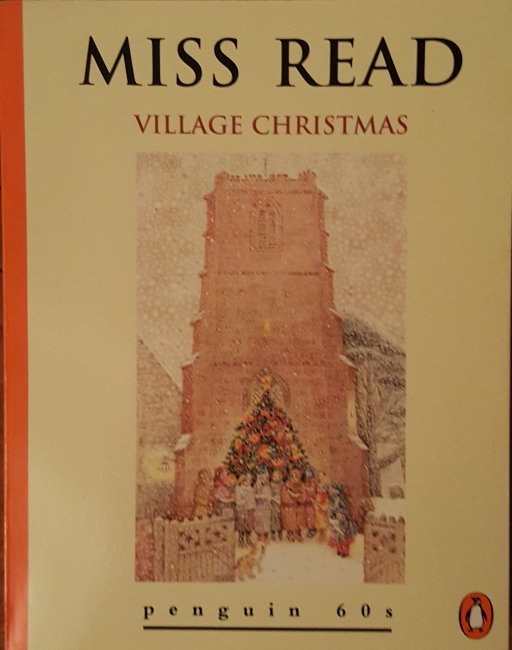
Village Christmas – Miss Read

By profession Dora Saint was a school teacher but is best known for her portrayals of English village life under the pen name of Miss Read and the work on her numerous novels and short stories largely took over her working life after WWII. Miss Read is not only the author of the books but in a lot of them she is also a character as a schoolmistress in the fictional village of Fairacre. Although this story is set in Fairacre Miss Read herself does not actually appear instead we are concerned with the ageing spinster sisters Margaret and Mary Waters and the family that had moved in over the road a few months earlier in September.

Initially the Waters sisters were somewhat wary of the new family as they lived a very quiet life and suddenly having three small children and a mother clearly pregnant with a fourth moving in so close was disconcerting. Mrs Emery’s personality was a bit too outgoing for their taste but also to the sisters eyes she was also rather badly dressed so they were unsure what to make of her, the children however were unfailingly polite so there was clearly something being done right in the new household. The story leaps on over the three months to Christmas morning when the sisters are interrupted at breakfast by one of the Emery girls coming for help as their mother is having the baby early and their father had been called away as a relative had had a stroke. Now two spinsters are not ideal midwives and the nurse or doctor couldn’t be contacted so we are taken through their rising panic as they realise that very little preparation had been done as Mrs Emery had clearly not expected to give birth on Christmas day.

One goes over to help Mrs Emery, who is easily the least concerned of everyone, whilst the other sister takes the children back over to her house to keep them entertained and fed and most importantly out of the way whilst trying to contact the nurse and also Mr Emery to let him know what is happening and get him back to Fairacre. It’s a delightful story of how the Waters sisters had a very different Christmas to the one they expected and this was the first time I had read any of Miss Read’s works. I think I’ll definitely tackle another somewhat longer book for my next go at her books, after all there are a lot to have a go at with twenty books set in Fairacre, thirteen novels set in the nearby village of Thrush Green, ten children’s books and a few other titles not set in the two main villages or of a factual nature rather than fiction.

Village Christmas was first published in 1966 although my copy of the book was published in 1995 as part of the Penguin Books 60th anniversary celebrations and it is also available with the two other Christmas tales Miss Read wrote as a single volume, these being Christmas Mouse (1973) and No Holly for Miss Quinn (1976). Confusingly this combination book appears to also be called Village Christmas.

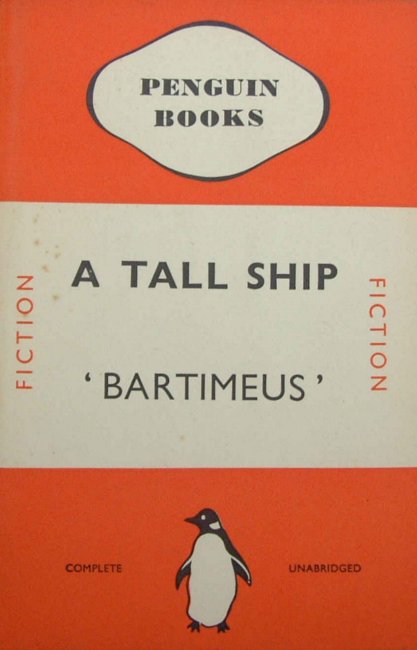
A Tall Ship – ‘Bartimeus’

Originally published in September 1915 by a by then well known author of naval stories I was expecting tales of daring do on the high seas so was quite surprised that with the exception of the first and last stories in this collection the actual war didn’t really impinge on the stories being told. It all starts excitingly enough with the short story ‘Crab-pots’ which begins with the torpedoing of a ship and the unusual revenge that one of the sailors manages to take some time later. This sailor will become part of a recurring group through most of the other nine stories in this collection but this isn’t clear at the start as he gains the nickname Torps by story number two ‘The Drum’ which is also one of the odder tales as it has two parts with no link between them. This story starts with a couple of Cornish fishermen repairing a boat by hammering out an old boiler to make a plate to cover worn out timbers and then jumps to Torps and Margaret (who had nursed him after the sinking of his ship) on a hillside looking out to sea and not really getting anywhere as to a relationship that he clearly wants but she is not sure about.

I don’t want to work my way through all the tales but there is one which just consists of recounting the morning work of a naval captain, doing his paperwork and dealing with requests from the sailors under his command. Another has the ships officers arranging a children’s party on board which has one of the funniest lines in the entire book which takes place between two of the children on the harbour side waiting to be picked up on a small boat in what looked like choppy conditions

“My daddy’s a Captain” continued Cornelius James “and I’m never sick – Are you?”
She nodded her fair head. “Yeth” she lisped sadly.
“P’raps your daddy isn’t a Captain” conceded Cornelius James magnificently.
The maiden shook her head. “My daddy’s an Admiral” was the slightly disconcerting reply.

All in all though the book was remarkably dull and it’s no surprise to see that it and the other works by Bartimeus are long out of print. He was definitely popular in his time though but it’s hard to see why, this is the second book by him in the first 110 Penguin books a feat only matched by Agatha Christie and Andre Maurois (excluding two part books) but none of his other works have ever appeared in Penguin unlike the two other authors so it is clear he was waning in popularity even in the mid 1930’s.

As can be seen from the rear flap of the dust wrapper there are quite a lot of clues as to who the pseudonymous Bartimeus actually was. A little digging finds that the author was born Lewis Anselm da Costa Ricci in 1886; although he anglicised his name to Ritchie by deed pole in 1941. Joining the Royal Navy in 1901 he trained to become a naval officer, however while still young, he contracted Malta Fever (brucellosis); this cost him the sight of one eye and damaged the other. Unable now to pursue a career at sea, he remained in the Navy, initially in the accounting branch, but began writing stories about naval life. He finally left the Navy at the start of the Second World War retiring as captain of the Royal Yacht and became press secretary to King George VI from 1944 to 1947. He took his pen-name from the Bible, ironically hinting at his reason for leaving the career he loved by naming himself after Bartimeus, the blind beggar of Mark 10, 46-52.

The Book of Tea – Kakuzo Okakura

From the second series of Penguin Books little black classics this charming book was first published in 1906 and seems to have been in print for most of the time since with a succession of publishers bringing out editions over the years all over the world, this edition was published in 2016. Kakuzo Okakura was born in Yokohama in 1862 and lived his whole life in Japan although travelled extensively promoting Japanese arts and working to preserve traditional techniques at home. Unusually for a Japanese writer of the time he mainly wrote in English and this, his most famous work outside of Japan, is no exception thus helping to spread his insights into Japanese life and arts to a wider audience. This short (109 pages) book is ostensibly about tea but it is in reality so much more.

The opening chapter pulls no punches in his description of the misunderstandings between East and West and his conclusion that both sides see themselves as the height of enlightenment and the other as little better than barbarians

The beginning of the twentieth century would have been spared the spectacle of sanguinary warfare if Russia had condescended to know Japan better. What dire consequences to humanity lie in the contemptuous ignoring of Eastern problems? European imperialism, which does not disdain to raise the absurd cry of the Yellow Peril, fails to realise that Asia may also awaken to the cruel sense of the White Disaster.

Japan was unknown to the West until the sixteenth century and was therefore influenced by its neighbours, specifically China, where it got tea from originally, and its own cultural norms surrounding Taoism and Zen. Early in the seventeenth century and for two and a half centuries after that during the Edo period Japan had cut itself off from the rest of the world and only regained a place amongst other countries when forced to open up by the United States navy in 1854. This enforced isolationist policy meant that Japan had developed very differently from the West especially in aesthetic traditions and the importance of tea and the ceremonial around drinking it is one of these art forms unique to Japan and which goes back millennia. Okakura refers to Teaism which he sees as developing from Taoism but wrapped in the sacred nature of the tea ceremony and more specifically the tea house where the ceremony takes place. The dimensions and layout of the tea house is vitally important as is the simplicity of its construction and decoration. The separate entrance for the guests and the tea master leading to a room where the only decoration is in the tokonoma, an alcove where items can be displayed, and the choice of decoration is normally minimalist to western eyes, maybe a single flowering branch or a finely produced scroll or hanging. The idea of a matching tea service as seen in the west is anathema to the Japanese ceremony where if the kettle is round the jug for the water will be angular, contrast is important.

Okakura also gives a history of the three ways tea has been prepared, two of which had fallen out of fashion by the time the west discovered tea so we only have the third method using the steeping of leaves as our means of producing tea. Initially back in the fourth of fifth centuries there was a sort of pressed cake of powdered tea

the method of drinking tea at this stage was primitive in the extreme. The leaves were steamed, crushed in a mortar, made into a cake, and boiled together with rice, ginger, salt, orange peel, spices, milk, and sometimes with onions! The custom obtains at the present day among the Tibetans and various Mongolian tribes, who make a curious syrup of these ingredients.

Later on we have Luwuh in the middle of the eighth century who first wrote down and formalised the making of tea and this is the second method using finely powdered tea which was whisked with a bamboo whisk and Okakura extracts from ‘The Chaking’ his three volume book on tea

In the fifth chapter Luwuh describes the method of making tea. He eliminates all ingredients except salt. He dwells also on the much discussed question of the choice of water and the degree of boiling it. According to him, the mountain spring is the best, the river water and the spring water come next in the order of excellence. There are three stages of boiling: the first boil is when the little bubbles like the eye of fishes swim on the surface; the second boil is when the bubbles are like crystal beads rolling in a fountain; the third boil is when the billows surge wildly in the kettle. The Cake-tea is roasted before the fire until it becomes soft like a baby’s arm and is shredded into powder between pieces of fine paper. Salt is put in the first boil, the tea in the second. At the third boil, a dipperful of cold water is poured into the kettle to settle the tea and revive the “youth of the water.” Then the beverage was poured into cups and drunk. O nectar!

There is also a chapter on flowers in Okakura’s little book which given the significance of the decoration in the tokonoma and also in the garden approach to the tea house is not surprising however he turns it into almost a diatribe against the cruelty of people to flowers by picking them and watching them die in their homes. The book finishes with a chapter on tea masters of which the greatest of all is Sen no Rikyū (Rikiu in the book) from the sixteenth century who refined the tea ceremony and the tea room to how it is seen now and at the very end we have his final ever tea ceremony at the end of which he commits ritual suicide on the orders of his lord and master.

I’ve no idea what I expected from this book but it is much, much more than I could have thought. There is great insight into the Japanese traditions and the development over centuries of a culture so different to our own, it’s definitely worth seeking out.

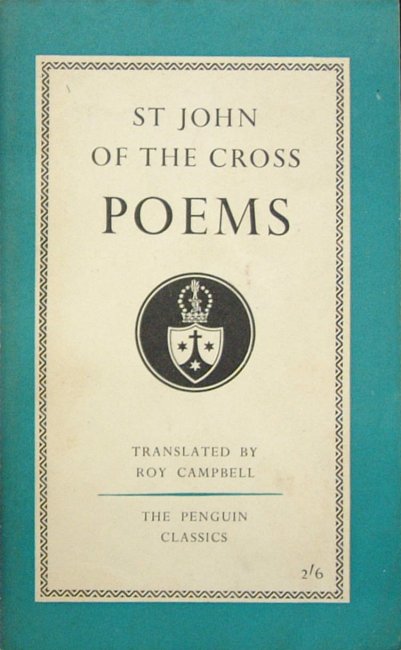
Poems – St John of the Cross

For this, the 200th post in this blog, I have chosen a Penguin Classic translation of the poetry of St. John of the Cross, the 16th century Spanish mystic christian and follower of Teresa of Ávila whose writings have also appeared in the Penguin Classics catalogue. The book is actually rather more than a translation as it is a parallel text edition with the original Spanish text on the left hand pages and the English on the right. Saint John (Juan de la Cruz in Spanish) was a Catholic priest and Carmelite friar involved in setting up religious houses in northern Spain but was also the greatest of the mystic poets in Spanish literature and indeed one of the giants of Spanish literature regardless of style or theme.

However, before discussing the poems, I would like to take a little time over the translator, much as the book does with a preface by his widow Mary Campbell. Roy Campbell was born in South Africa in 1901 and first came to England in 1919 where he met and married Mary in 1922 and they moved back to South Africa in 1925. He worked as an editor on a literary magazine whilst writing poetry but disagreed with the apartheid regime so moved back to London in 1927. On their return to England they fell in with the Bloomsbury Group and Mary started a lesbian affair with Vita Sackville-West at the same time as Virginia Woolf was also having an affair with Vita. Roy strongly, and reasonably, disapproved of his wife’s affair and to separate Mary and Vita the Campbell’s moved first to Provence and then to Toledo in Spain where Roy Campbell discovered the works of St John of the Cross and the couple converted to Roman Catholicism. It was in Toledo that St John had been imprisoned by rival Carmelite monks opposed to the very strict variant of the calling espoused by Teresa and John, he wrote most of his poems during his confinement. Roy Campbell, by the 1930’s, was becoming a well known poet in his own right and was fascinated by the poems of St John and whats more his heroic poetic style seemed ideally suited to the extant works of St John so he began work on a translation that was finally published by Harvill in 1951 and won the 1952 Foyle Prize. It is this verse translation that is reprinted in the 1960 Penguin first edition that I have, Roy Campbell having died in 1957 hence his widow penning the preface where she completely fails to mention the lesbian affair that took them to Spain in the first place.

The Spanish text is by Padre Silverio de Santa Teresa CD, and first appeared in an UK book in 1933 published by the Liverpool Institute of Hispanic Studies.Roy Campbell has done an excellent job of translating the poems as not only has he translated the text but found English words which allow the lines to largely scan and always rhyme as the originals do. A moments thought would tell you how difficult this is and why many poetry translations don’t attempt this.The longest work is ‘Songs between the soul and the bridegroom’ where the poem is in the form of a conversation between the two parts where God is gradually revealed to be the bridegroom that the soul or bride is conversing with. I really enjoyed this one as there is more time for development of the story within the poem as it goes on for seven pages, most are less than a page and a half and some are simply one verse.

Several of the poems use repetition of the last line of each verse such as ‘Song of the Soul that is Glad to Know God by Faith’ where each verse, apart from the eleventh, ends “Aunque es de noche” (Although it is night) although with this particular poem Campbell varies the last line between “Although by night” and “Though it be night” and I’m not sure why he made the change as reading it with “Although by night” seems to scan perfectly well with each verse. My favourite poem of the collection though is ‘Verses about the soul that suffers with impatience to see God’ and this is another where repetition of the last line of each verse is utilised although this time it is the sense of the last line that is repeated as the words vary between “Am dying that I do not die”, “And die because I do not die”, “The more I live the more must die” etc. culminating in the more hopeful “I live because I’ve ceased to die”.

I was surprised by how much I enjoyed this volume of poetry as I’m not remotely religious, let alone Catholic, so am clearly not the target audience. I suspect this is partly down to the way religion is handled in English schools where is is taught as a ‘normal’ subject and after all nobody asks you to believe in geography.

No Bed for Bacon – Caryl Brahms & S J Simon

Doris Abrahams and Simon Jacoblivitch Skidelsky, better known as Caryl Brahms and S J Simon respectively, collaborated on eleven comic novels and crime stories between 1937 and 1948 when S J Simon died suddenly at the age of just 44. No Bed for Bacon was their sixth book, first published in 1941, and is a comic retelling of Elizabethan England featuring William Shakespeare, Francis Bacon, Walter Raleigh, Queen Elizabeth herself and numerous other famous characters from the period. Caryl Brahms was best known as a theatre, especially ballet, critic and S J Simon was a journalist but much more famous in the world of contract bridge where he was European champion and also the author of books on the subject.

Well this was a fun romp round Elizabethan London with lots of running gags including the one that gives the book its title which is Sir Francis Bacon’s desperate attempt to get hold of a bed that Queen Elizabeth had slept in during one of her many progressions around England which was seen as a major status symbol in ones home. In this he is constantly thwarted partly at the hands of the Master of the Revels who controls all such progressions but also bu Elizabeth herself who knowing of his desire for such an item of furniture ensures that it never goes to him. Other running jokes include William Skakespeare constantly trying out spellings for his name, which definitely has a basis in fact because all the known remaining signatures by Shakespeare are spelt differently. Sir Walter Raleigh keeps getting a new and ever more flashy cloak only for it to be ruined within a couple of hours, from the, probably apocryphal, tale of him using his cloak to keep the Queens feet dry when her carriage stopped by a puddle and in contrast Lord Burghley keeps being dressed in more and more shabby attire. Shakespeare also keeps trying to start a new play called Loves Labours Wonne as a companion piece to Loves Labours Lost which famously has not survived to the present day even assuming that he ever finished it in reality and the regular sections in terrible Elizabethan spelling also add to the joy of reading the book.

The opening character remains anonymous through the work yet appears regularly always doing a different job as he makes a rapid rise, and even faster fall through the ranks of the proletariat from horse holder outside a theatre, to watchman, soldier, manservant, prisoner and back to watchman amongst many other jobs too numerous to list. He invariably starts any chapter actually set in London and you get used to seeing what he has managed to become this time. The other main fictional character, most of the people in the book really existed, is the young Lady Viola who disguises herself as a boy in order to join Shakespeare’s company as an actor as females were not allowed on the stage at the time and ultimately falls in love with him. If this sounds familiar than you have probably seen the 1998 film Shakespeare in Love where Gwyneth Paltrow plays Lady Viola who disguises herself as a man in order to join Shakespeare’s company as an actor as females were not allowed on the stage at the time and ultimately falls in love with him. Just a reminder that the book was written in 1941 and Tom Stoppard, who co-wrote the film is known to have had a copy of the book but claims to have not been influenced by it despite even using the same character name and no credits to Brahms or Simon are given in the film.

The book does play fast and loose with historical accuracy (as does the film which nicked the plot) but one of the most poignant sections and indeed the longest chapter of the novel takes place on a boat on the Thames with Queen Elizabeth progressing down the river in the company of her famous military and naval commanders whilst reliving the routing of the Spanish Armada. From what I remember of my Tudor history lessons this does appear to be mainly factually correct although it does contain Sir Francis Drake completing his game of bowls on Plymouth Hoe before heading out to meet the enemy which almost certainly didn’t happen. There are various sidelong comments regarding Drake being lucky with the wind which however was certainly correct.

Forsooth, tis a merrie romp Master Will and I definitely recommend the novel assuming you can lay your hands on a copy as it appears to have been out of print for a couple of decades but there are plenty of copies available on abebooks.

My copy is the first Penguin Books edition published in December 1948 five months after the death of S J Simon, Carly Brahms greatly outlived him and died just 3 days short of her 81st birthday in 1982.

Clochemerle – Gabriel Chevallier

Just possibly the most fun book I have read this year, it is delightfully written with the author taking the role of narrator and introducing us to the small Beaujolais town of Clochmerle and it’s comical inhabitants in the way of a consummate storyteller. Every character and place is beautifully described, and at length, so that you can fully realise in your minds eye each and every one of them. It is the third in my August book theme of ‘translated from French’ and it has been an absolute joy to read even though it clocks in at 320 pages.

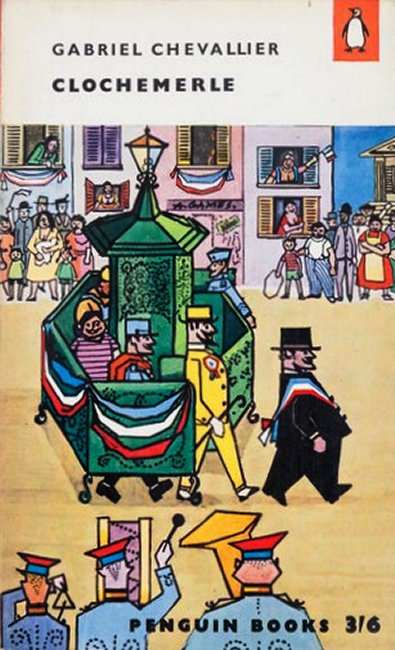
It all starts with the decision of the local mayor to bring progress to his sleepy town by building a public urinal and due to the odd geography of the place the best location is half way up the main street which places it firmly outside the church. Although not as indicated on the cover of this Penguin edition as it is placed not in the centre of a square but up against a wall adjacent to the Beaujolais Stores on an alley leading up to the church itself. To get a feel for the wonderful descriptions in the book let’s look at page one and the two men walking down the road from the square to where the urinal is to be situated.

One of these men, past fifty years of age, tall, far-haired, of sanguine complexion, could have been taken as a typical descendent of the Burgundians who formally inhabited the department of the Rhone. His face, the skin of which was dented by exposure to sun and wind, owed its expression almost entirely to his small, light grey eyes, which were surrounded by tiny wrinkles, and which he was perpetually blinking; this gave him an air of roguishness, harsh at times and at others friendly. His mouth which might have given indications of character that could not be read in his eyes, was entirely hidden by his drooping moustache, beneath which was thrust the stem of a short black pipe, smelling of a mixture of tobacco and of dried grape-skins, which he chewed at rather than smoked. Thin and gaunt, with long, straight legs, and a slight paunch which was more the outcome of lack of exercise than a genuine stoutness, the man gave the impression of a powerful physique. Although carelessly dressed from his comfortable, well-polished shoes, the good quality of the cloth of his coat, and the collar which he wore with natural ease on a week-day, you guessed that he was respected and well-to-do. His voice, and his sparing use of gesture were those of a man accustomed to rule.

And there we have a perfect pen-portrait of Barthélemy Piéchut, mayor of the town, a man of ambition to go far in the party and for which mayorality of a small provincial town was to be just a stepping stone. His fellow walker is Ernest Tafardel the schoolmaster and a far more devout republican than his friend although not destined to rise any higher than his current role. Against these two redoubtable men of the Third Republic there is the powerful Catholic Church although represented in Clochemerle by the Curé Ponosse a man who joined the priesthood for a quiet life and is definitely not the man for the crisis to come. However there is also the old maid, Mademoiselle Putet, full of religious fervour with nothing else to drive her forward now it had become quite clear she was destined to remain a Mademoiselle and untouched by the male sex rather than a married Madame. She it is that stirs up the trouble between the church and the state, initially over the urinal which as she lives by the church at the end of the alley where it is placed she sees as a personal affront to her dignity, but later as she interferes in the various goings on of the population.

The stage is set for a farcical ‘war’ between to two sides which is reflected in another conflict also in the location of the urinal between the two most attractive women in the town who run the Beaujolais Stores in the case of Judith and the bar of Torbayon in the case of Adéle which are directly opposite one another. Judith is well known for being free with her charms so to speak and Adéle flaunts hers rather than directly engaging in extra-marital affairs unlike Judith but this all changes when Judith’s particular favourite, who is staying at the Torbayon Inn, is taken ill and nursed by Adéle who takes advantage of his bed ridden state to discover exactly what she is missing in her own marriage. All this takes place in the long, hot summer of 1923 when tempers are getting frayed due to the heat and the annual fete is the cause of excessive drinking on all sides. The cast of minor characters is beautifully drawn and all have part to play in the ultimate fiasco and its resultant tragedy from the washerwomen of the lower town to the baroness in her chateau above the town, through the government officials more interested in cars and their private dealings and the military who can’t be bothered to intervene.

The book ends with an overview ten years after the calamities of 1923 by bringing us up to date with the happenings to most of the protagonists since then and all is well with most of them and the town now boasts three urinals, a great step forward indeed. There are apparently two sequels 1951’s Clochemerle Babylone and from 1963 Clochemerle-les-Bains both of which at least were available in Penguin so I can definitely see me hunting these out for future reading even if they are out of print which they appear to be.

Candide – Voltaire

What on Earth have I just read? I don’t really know what I was expecting from the fourth book issued in the Penguin Classics series, maybe a serious French novel, but it certainly wasn’t this surreal fantasy adventure. Penguin Classics started in 1946 with Homer’s Odyssey and then followed that with a collection of short stories by Guy de Maupassant and then the Theban plays by Sophocles, all solid classics as expected and then came this truly bizarre narrative at the end of 1947. This is the second of the blogs making up my August theme for 2021 which is ‘translated from French’, as I have already featured Boule de Suif and Other Stories by Maupassant I selected this book as the second French book in the Penguin Classics without knowing anything at all about it before I started reading this week.

The only book I can think of that has such fantastical episodes is Jonathan Swift’s Gulliver’s Travels and like that other classic this is a satirical parody, however unlike Swift’s book which is set in various fantasy lands Voltaire has set his amongst contemporary events and real people. The problem with both books is that they are over two hundred and fifty years old so the politics and philosophies they are parodying are long gone and the messages that would have been clear to readers at the time are obscure at best or completely lost to the modern reader. This if anything makes them even stranger. Still on with the review of the book in hand, which was first published in 1759.

As is my usual practice with books which have an introduction I didn’t read it first but after I had completed the novel. As usual I’m glad I did as the introduction not only gives away large parts of the plot whilst trying to explain the references it also totally reveals the ending. However the introduction is essential after reading the book because it answers so many questions the modern reader has, such as why does Professor Pangloss teach that this is “the best of all possible worlds” and anything that happens must ultimately be for the best despite the continuous disasters that surround him and his pupil Candide; including in Pangloss’s case being hung as part of a Portuguese auto-de-fe following the 1755 Lisbon earthquake which killed tens of thousands of people. It turns out that Voltaire was mercilessly sending up the Theodicy by Gottfried Leibniz which takes as it central premise that exact philosophy.

The book starts with Candide and Pangloss at the Baron Thunder-ten-tronckh’s country seat in Westphalia along with the Baron’s family, especially his seventeen year old daughter Cunégonde who Candide is madly in love with, all is well with the world. Cunégonde sees Pangloss making love with one of the maids and decides to entice Candide but this is seen by the Baron who kicks Candide out of the house before he can make a move. Candide is then captured by the Prussian army, press-ganged into service, flogged almost to death, made to fight in a war with the French and nearly executed before escaping to Holland, Here he meets Jacques the Anabaptist and then runs into Pangloss who is now a beggar with syphilis which he caught from the maid and who informs Candide that soon after he left the castle was over-run by the Prussians, Cunégonde was raped before her and all other inhabitants of the place were killed. Pangloss is cured of syphilis by Jacques, losing an eye and an ear during the treatment. We are now on page ELEVEN. The frenetic pace continues through the rest of the book along with the rapidly rising death toll and never ending coincidences and disasters surrounding the characters. Throughout it all Candide and Pangloss maintain the Leibnizian philosophy of this is the best of all worlds.

The other protagonists in the book are increasingly strange especially the ‘old woman’ whose tale is the most bizarre of all and acts as a balance to Candide as she certainly doesn’t believe that this is the best of all worlds after the life she has had. Starting as the illegitimate daughter of Pope Urban X and ending as a servant in Lisbon by the time she meets Candide, on the way seeing her mother drawn and quartered, becoming a slave and having a buttock cut off to feed starving Janissaries during a siege amongst other experiences. The surreal happenings to all the characters continue throughout the book which travels to South America and back to Europe via El Dorado dropping in at England just long enough to witness the execution of Admiral Byng for failing to prevent the fall of Minorca to the French and deciding that England was just too crazy a place to stay, which bearing in mind the things that had already befallen them by then was a pretty damning indictment.

I think I need to read Candide again in a few months just to fully resolve in my mind all that happens but if you like books at a mad pace then Candide is for you. I also have a copy as part of the Penguin Drop Caps series, translated by Theo Cuffe.

Death and the Dancing Footman – Ngaio Marsh

Part of the Ngaio Marsh million, one hundred thousand copies of each of ten books by Marsh published by Penguin Books in July 1949, this is one of the three books included that had not been published by Penguin prior to this collection. I have reviewed one of the other titles included, ‘Enter a Murderer’, back in August 2018 as part of the ‘first Penguin crime set‘ which were all first published by Penguin in August 1938. As I explained at the time:

New Zealand’s Ngaio Marsh was considered in her time to be one of the ‘Queens of Crime’ along with Agatha Christie, Dorothy L Sayers and Margery Allingham and is best known for her detective stories featuring Roderick Alleyn of the London Metropolitan Police. 

This is another of those Chief Detective Inspector Alleyn crime mysteries. As a general rule most crime novels of the 1930’s and 1940’s clock in at about 200 to 225 pages but this one is surprisingly long for the period at 315 pages in the Penguin edition and I have to say that it is a very slow starter with scene setting and character introductions meaning that it doesn’t really get going until around page 70. If I hadn’t been convinced of Marsh’s ability to spin a tale I might have given up before then but it is well worth hanging on in there. The story is a twist on the ‘locked room’ type of crime novel in that the victim and the murderer are from the fixed group of people we have been introduced to, in this case because the grand country house that they are all in is surrounded by impassable snowdrifts and even the phone lines are down so they can have no contact with the outside world. That it is established early on in the novel that Alleyn is taking a break in the nearest village to where the murder takes place allows Marsh to bring him in even though he is clearly out of his jurisdiction but he is the only policeman anyone can get hold of.

The premise of the story is that Jonathan Royal, the owner of Highfold, decides to give a house party and for his own amusement chooses a group of people who all, for one reason or another, have an antagonistic feeling regarding at least one of the other guests. It is implied that he is hoping for some sort of reconciliation in one or more of the disagreements but will be quite happy if this doesn’t happen and is confident in his ability as a host to at least hold the group together. It will be a sort of unscripted play and with this in mind he has also invited a neutral player. Aubrey Mandrake is an avant garde, if not surrealist playwright who knows none of the other guests, Royal has backed some of his plays and has now invited him to be the audience in his own experimental theatre. Due to the animosity between the guests each has has a reason for, if not murder, then at least wishing harm to another and all these various hostilities are explained right at the start of the book as Jonathan Royal brings Mandrake into his confidence as to what he has planned. The complicated relationships between the other seven guests and the need to go into detail about them is one of the reasons for the slow start and it is only later as the interactions unfold that you realise that you actually need all that information in order to keep track of the various goings on.

Much to my surprise I got the murderer right, well before the denouement, although not all the finer detail as to how it was done, or rather how the alibi was done. Alleyn of course regarded the solution as trivial and he had largely wrapped up the case in his mind within a couple of hours of arriving at Highfold, his problem was proving it especially without access to his usual fellow policemen. All in all an excellent read for a dull and rainy July weekend and I do like a good detective story as a means of giving your brain a workout.

As an aside, I did like that characters in this book are clearly readers of detective fiction, in particular Dorothy L Sayers’ very popular Lord Peter Wimsey tales. On page 206 of this edition they reference Busman’s Honeymoon which I reviewed in September 2020.

“Could Hart have set a second booby trap.” “Do you mean could he have done something with that frightful weapon that would make it fall on …? Is that what you mean?”
“Yes. I can’t get any further, though. I can’t think of anything”
“A ‘Busman’s Honeymoonish’ sort of contraption? But there are no hanging flower-pots at Highfold”

Death and the Dancing Footman was first published in 1942 although mine is the first Penguin edition from 1949. Busman’s Honeymoon had come out just five years earlier in 1937 but had clearly been a major seller if Marsh could so easily drop in a reference to it. There is a slight nod to the plot of Busman’s Honeymoon in the solution to this case although the hint taken from the murder method in that book in the quote above is also a diversion from the actual method in this one so it was clearly a much loved book by Marsh.

Three Letters from The Andes – Patrick Leigh Fermor

In 1971 Patrick Leigh Fermor, already by then a respected travel writer, but still six years before he published his best known work ‘A Time of Gifts’, went with five friends to the Andes in Peru. This book consists of three long letters to his wife although he never actually posted the third one as he didn’t finish it until he was on his way home. The expedition was part of a trip organised by his fellow members of the Andean Society in London using privately chartered aircraft to get to and from Peru from London and Fermor’s friends were intent on exploring and scaling the peaks of a relatively unknown part of the Andes mountain range. If all this sounds expensive then it probably was but Fermor and his colleagues could certainly afford it, most of the party were highly experienced climbers:

  • Robin Fedden – Leader of this expedition, Deputy Director-General of Historic Buildings for The National Trust, a writer and diplomat
  • Renee Fedden – Robin’s wife and co leader of the expedition
  • Carl Natar – Ex world ski champion and London manager of famous jewellers Cartier for three decades
  • Andre Choremi – Lawyer and social anthropologist

Along with them were a couple of non climbers

  • Andrew Cavendish – 11th Duke of Devonshire and a keen amateur botanist looking for rare plants to grow at his stately home Chatsworth House in Derbyshire
  • Patrick Fermor – travel writer, just along to spend six weeks with his friends and explore the area with them.

The letters were not intended for publication, and it took twenty years before they were, after what Fermor describes as a general tidy up but not much. That these were originally just letters leads to the main criticism levelled at the book in that it is not as polished as his other works and it feels more like an old boys outing with irrelevant chit chat coming to the fore. Well yes, these are letters to his wife who knew most, if not all, the other people involved and recording the conversations between them is entirely right in that context. I quite like the chattiness of the style and I raced through the book, reading it in just two sessions, as I found it quite difficult to put down once I had started reading. It is full of beautiful descriptive passages as he tries to convey the beauty of the surroundings. To illustrate this I’m just going to open the book at random and quote whatever I find.

The mountains draw back of either side of an airy lift and fall of savannah. As our caravan picked its way over the edge and headed downhill, orange-flowered organ-cactus and myrtle and tamarisk rose up and the air began to smell of spice. There was a blazing sky of very pale blue.

From the second letter

You could almost be there, in just three short sentences Fermor has captured his environs perfectly and as I said this is literally a random sample, not a passage I had picked out in advance, opening the book anywhere will show his talent to take the reader with him which would be displayed fully in his masterpiece of travel writing, ‘A Time for Gifts’. After the climbing expedition the friends head off to Lake Titicaca where they end up in a terrible hotel and the sections covering their always exasperating dealings with the manager and the chef who appears to be incapable of even boiling an egg successfully are very funny. A sudden announcement that there is actually hot water for a change will have the group dive for the showers only for the water to turn icy cold just as they were starting to enjoy finally getting clean. You have to wonder if the manager was incompetent or simply didn’t care about the people staying there. It was only when Andrew in frustration at yet another rock hard egg for breakfast threw it across the dining room did conditions start to improve.

As usual with Fermor the book is thoroughly entertaining and I definitely recommend it.